
Speak To An Expert
Get clear, personalised advice for your situation.
Jot down a few questions to make the most of your conversation.
How is Hypotony Diagnosed?
Hypotony refers to a condition where the intraocular pressure (IOP) within the eye is abnormally low, typically less than 6 mmHg. This can lead to structural changes and impaired visual function if not appropriately diagnosed and managed. In the UK, the diagnosis of hypotony is a systematic process that involves various steps and examinations typically carried out by an ophthalmologist.
Initially, the symptoms prompting a visit to an eye specialist can include decreased vision, distortion of vision, or discomfort in the affected eye. To begin diagnosing hypotony, the ophthalmologist will take a thorough medical history to understand potential underlying causes such as recent eye surgery, traumas, or existing eye diseases.
The cornerstone of diagnosing hypotony is measuring the intraocular pressure. This procedure is most commonly performed using a device called a tonometer. The Goldmann applanation tonometer is the gold standard and is often used during an eye examination. It involves applying a small amount of pressure to the cornea to measure IOP. For patients in the UK, especially children or those uncomfortable with direct contact methods, devices like the non-contact tonometer (‘air puff’) or digital tonometry options may also be utilized.
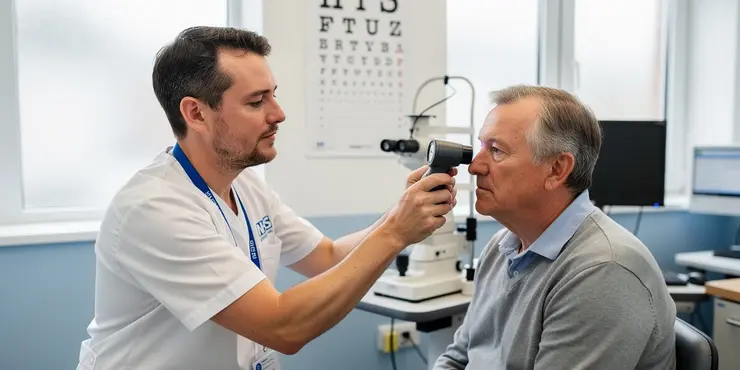
In conjunction with IOP measurement, a comprehensive eye examination is conducted. This includes visual acuity tests to assess the level of vision impairment. Additionally, a slit-lamp examination is crucial as it provides a magnified view of the eye's structures, allowing the ophthalmologist to detect any signs of anterior segment abnormalities. Evaluation of the fundus through ophthalmoscopy is also important to check for potential damage to the retina and optic nerve.
Moreover, ancillary tests might include optical coherence tomography (OCT) to visualize the retina’s cross-sectional structure, helping to identify retinal detachment or macular edema, both of which can be associated with hypotony. Ultrasound biomicroscopy is another diagnostic modality that can be employed, particularly if there is a suspicion of posterior segment complications.
In the NHS setting, the process of diagnosing hypotony is complemented by laboratory investigations if systemic causes are suspected. For example, blood tests might be performed to rule out inflammatory or infectious causes. In some cases, if a connection between hypotony and systemic diseases like rheumatoid arthritis is suspected, referral to a specialist may be recommended.
The final diagnosis of hypotony is made after synthesizing the clinical examination results and diagnostic test findings. It is essential for the correct diagnosis to be established promptly to implement an appropriate management strategy and prevent long-term damage to the eye and vision.
Frequently Asked Questions
Hypotony is a condition where the intraocular pressure (IOP) in the eye is abnormally low, usually below 6-8 mmHg.
Diagnosing hypotony is crucial because low intraocular pressure can lead to vision problems, including distortion, vision loss, and even structural damage to the eye.
Common symptoms include blurred vision, distortion, discomfort in the eye, and in severe cases, vision loss.
Hypotony is diagnosed by measuring the intraocular pressure using a tonometer, and through a comprehensive eye examination by an ophthalmologist.
A tonometer is used to measure intraocular pressure. Types include Goldmann applanation tonometry, non-contact tonometry, and handheld tonometry devices.
A slit lamp examination helps to identify structural abnormalities or damage in the eye that may be associated with hypotony.
Yes, imaging tests such as ultrasound biomicroscopy or OCT can help assess the anatomy of the anterior segment and identify changes due to hypotony.
The normal range for intraocular pressure is generally between 10 and 21 mmHg.
Yes, during a regular eye exam, an ophthalmologist can check for low intraocular pressure and identify symptoms indicative of hypotony.
Risk factors such as recent eye surgery, trauma, or conditions like cataracts or glaucoma may increase the need for testing for hypotony.
Conditions such as uveitis, retinal detachment, or macular edema might present with similar symptoms but are distinct from hypotony.
Clinicians rely on a combination of IOP measurements, ocular structure assessment, patient history, and symptom review to differentiate hypotony from other conditions.
Relevant history includes previous eye surgeries, trauma, family history of eye disorders, and any systemic diseases that might affect eye health.
Yes, hypotony can be temporary, especially if it's related to a specific cause like a post-surgical period or transient leak in the eye.
Signs include low IOP readings, a shallow anterior chamber, and decreased ocular rigidity visible during an eye exam.
An ophthalmologist confirms hypotony through repeated IOP measurements, comprehensive clinical examination, and exclusion of other conditions.
Yes, in some cases patients might not exhibit noticeable symptoms, particularly in the early stages.
Undiagnosed hypotony can lead to vision distortion, choroidal detachment, phthisis bulbi, or permanent vision loss if untreated.
The frequency depends on the individual's risk factors and clinical condition, but regular monitoring is essential for those with known risk factors.
Follow-up involves regular IOP monitoring, addressing underlying causes, and potentially corrective procedures to restore normal pressure.

Ergsy Search Results
This website offers general information and is not a substitute for professional advice.
Always seek guidance from qualified professionals.
If you have any medical concerns or need urgent help, contact a healthcare professional or emergency services immediately.
Some of this content was generated with AI assistance. We've done our best to keep it accurate, helpful, and human-friendly.
- Ergsy carefully checks the information in the videos we provide here.
- Videos shown by Youtube after a video has completed, have NOT been reviewed by ERGSY.
- To view, click the arrow in centre of video.
- Most of the videos you find here will have subtitles and/or closed captions available.
- You may need to turn these on, and choose your preferred language.
- Go to the video you'd like to watch.
- If closed captions (CC) are available, settings will be visible on the bottom right of the video player.
- To turn on Captions, click settings.
- To turn off Captions, click settings again.