
Speak To An Expert
Get clear, personalised advice for your situation.
Jot down a few questions to make the most of your conversation.
What should I do if I suspect I have hypotony?
If you suspect that you have hypotony, which is a condition where the pressure inside the eye is lower than normal, it is important to seek medical attention promptly. Hypotony can lead to vision problems and other complications, so early intervention is crucial.
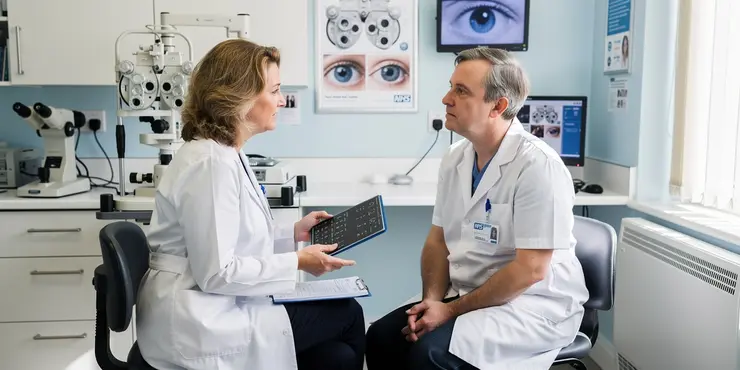
Firstly, you should arrange to see an optometrist or an ophthalmologist as soon as possible. In the UK, you can get your eyes checked at an optician's, and they can perform tests to measure the intraocular pressure (IOP) of your eyes. If the optometrist suspects hypotony, they may refer you to an ophthalmologist for further evaluation and treatment.
During the appointment, you might undergo a comprehensive eye examination. This includes measuring your eye pressure using a tonometer. A thorough examination of the eye may also be conducted using a slit lamp to check for any structural changes, such as choroidal folds, that might indicate hypotony.
It is important to provide your eye care professional with a complete medical history, including any recent eye surgeries, injuries, or treatments that could contribute to lowered eye pressure. Certain conditions, such as uveitis or retinal detachment, and procedures like trabeculectomy, can increase the risk of developing hypotony.
If hypotony is confirmed, the treatment plan will depend on the underlying cause. In some cases, the condition may resolve on its own, especially if it is due to a transient issue. However, if it is persistent or due to surgical complications, further medical or surgical intervention might be necessary.
Your eye specialist may recommend treatments like medications to manage any inflammation or prevent further fluid leakage from the eye. In some instances, surgical procedures may be required to correct any anatomical issues leading to hypotony, aiming to restore normal intraocular pressure.
While awaiting your appointment or diagnosis, it's essential to monitor your symptoms. Keep a note of any changes in your vision, such as blurriness or distortion, and any new symptoms that may arise. This information can be helpful to your healthcare provider.
If you experience any sudden or severe changes in vision, contact your healthcare provider immediately or visit an A&E department, as this could indicate a more serious condition requiring urgent attention.
Preventative measures are also important. Regular eye examinations can help detect changes in eye pressure early. If you have a history of eye conditions or surgery, follow up closely with your eye care provider to manage your eye health proactively.
In summary, if you suspect hypotony, seek professional medical advice promptly to ensure appropriate care and management. Monitoring your condition and adhering to recommended treatment plans will help preserve your vision and eye health.
Frequently Asked Questions
Hypotony is a condition where the intraocular pressure (IOP) within the eye is too low, typically below 5 mmHg. This can lead to visual problems and other complications.
Common symptoms include blurred vision, a feeling of pressure or discomfort in the eye, and sometimes seeing visual disturbances like flashes or floaters.
If you suspect you have hypotony, you should contact an eye care professional or ophthalmologist immediately for an evaluation.
Hypotony is diagnosed by measuring the intraocular pressure (IOP) using tonometry, and by conducting a thorough eye examination by an eye care professional.
If left untreated, hypotony can lead to long-term damage to the eye and potential permanent vision loss, so prompt treatment is essential.
Hypotony can be caused by surgical complications, trauma to the eye, inflammatory eye diseases, or certain medications.
Treatment options depend on the underlying cause and may include medications, surgical interventions, or procedures to repair damaged tissues or increase intraocular pressure.
While you cannot always prevent hypotony, managing risk factors, protecting your eyes from injury, and following medical advice post-eye surgery can help minimize risk.
Your ophthalmologist may advise you to avoid activities that can further decrease eye pressure or put stress on the eyes until your condition is treated.
Yes, hypotony can occur in one or both eyes, depending on the cause and underlying conditions.
While not always an immediate emergency, hypotony is a serious condition that requires prompt medical attention to prevent complications.
Low intraocular pressure can lead to visual distortions, blurred vision, or even more severe complications if the retina detaches.
Avoid rubbing your eyes or performing activities that could worsen symptoms. Rest your eyes as much as possible until you see a doctor.
You should seek medical attention as soon as possible if you suspect you have hypotony to prevent further complications.
Surgery may be necessary in some cases, especially if other treatments do not correct the condition or if there's an underlying structural issue.
Yes, hypotony can be temporary, especially if it occurs following eye surgery, but it is important to monitor and manage the condition under medical supervision.
In addition to tonometry, tests may include a slit lamp examination, ultrasound, and possibly imaging studies to assess the structures of the eye.
Treatment to adjust intraocular pressure may involve medications, procedures to close leaks, or surgical interventions depending on the cause.
Yes, certain medications, particularly those used to treat glaucoma, can potentially cause hypotony as a side effect.
Follow-up care may include regular eye exams to monitor pressure, manage any underlying conditions, and evaluate the effectiveness of treatment.

Ergsy Search Results
This website offers general information and is not a substitute for professional advice.
Always seek guidance from qualified professionals.
If you have any medical concerns or need urgent help, contact a healthcare professional or emergency services immediately.
Some of this content was generated with AI assistance. We've done our best to keep it accurate, helpful, and human-friendly.
- Ergsy carefully checks the information in the videos we provide here.
- Videos shown by Youtube after a video has completed, have NOT been reviewed by ERGSY.
- To view, click the arrow in centre of video.
- Most of the videos you find here will have subtitles and/or closed captions available.
- You may need to turn these on, and choose your preferred language.
- Go to the video you'd like to watch.
- If closed captions (CC) are available, settings will be visible on the bottom right of the video player.
- To turn on Captions, click settings.
- To turn off Captions, click settings again.