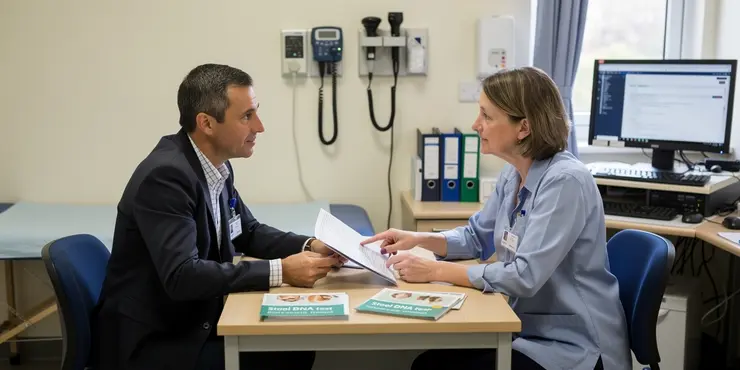

Speak To An Expert
Get clear, personalised advice for your situation.
Jot down a few questions to make the most of your conversation.
Understanding Stool DNA Tests
A stool DNA test is a non-invasive medical test used to screen for colorectal cancer and other gastrointestinal issues. The test examines a stool sample for specific DNA markers that can indicate the presence of cancerous or precancerous cells. This type of screening is particularly beneficial as it can detect abnormalities early, allowing for prompt intervention and management.
Do I Need a Prescription for a Stool DNA Test in the UK?
In the UK, accessing medical tests often requires a referral or prescription from a healthcare professional. This ensures the test is necessary based on your medical history and symptoms. Generally, a stool DNA test is included as part of a broader screening programme and may necessitate a prescription or recommendation from a doctor.
However, the availability of direct-to-consumer testing is evolving, and some private companies might offer stool DNA tests without a prescription. It is essential to consult with your GP or a healthcare provider before opting for a test outside the standard NHS procedures. This consultation can help determine the appropriate test and interpret the results accurately.
Accessing a Stool DNA Test Through the NHS
The NHS often prioritises more traditional screening methods for colorectal cancer, such as the faecal immunochemical test (FIT) or colonoscopy, owing to their established efficacy and cost-effectiveness. A stool DNA test might not be routinely offered unless specific conditions warrant its use. Discuss with your GP if you believe a stool DNA test is suitable for you. They can refer you to a specialist and decide if it aligns with your healthcare needs.
Private Healthcare Options
In the private healthcare sector, patients may have more flexibility in accessing stool DNA tests. Private insurance or out-of-pocket payments could facilitate obtaining the test based on your preference or a specialist's recommendation. Nonetheless, care should be taken to ensure that the provider is credible and that the test is validated for use in the UK.
Even in private healthcare settings, it is advisable to receive guidance from a healthcare professional to ensure the test is appropriate for monitoring your health condition, considering your medical history and risk factors.
Conclusion
While a prescription or referral is typically required to obtain a stool DNA test through the NHS, the private sector may offer alternative pathways. Consulting with a healthcare provider is crucial whether seeking a test through public or private means. This step ensures the test is necessary, accurately interpreted, and integrated into your overall healthcare plan effectively. Always prioritise tests that are authenticated and recommended by medical professionals to safeguard your health and well-being.
Understanding Stool DNA Tests
A stool DNA test looks at your poo to find signs of bowel cancer or other gut problems. It checks for DNA changes that might mean cancer or pre-cancer cells are present. This test is helpful because it can find problems early, so doctors can help you sooner.
Do I Need a Prescription for a Stool DNA Test in the UK?
In the UK, you usually need permission from a doctor to have medical tests. This is to make sure the test is right for you based on your health. A stool DNA test is usually done as part of a bigger health check-up. You might need a doctor’s note to get it.
Some private companies might let you do the test without a doctor’s note. But it’s a good idea to talk to your doctor first. They can help you choose the right test and explain the results.
Accessing a Stool DNA Test Through the NHS
The NHS often uses other tests for bowel cancer, like poo sample tests (FIT) or a camera to look inside your bowel (colonoscopy). A stool DNA test might not be offered unless there's a good reason. Talk to your doctor if you think you need this test. They can tell you if it’s the right choice for you.
Private Healthcare Options
If you pay for private healthcare, you might be able to get a stool DNA test more easily. You can use private health insurance or pay yourself. Make sure the place offering the test is trustworthy and the test is approved for use in the UK.
Even in private healthcare, it’s smart to ask a doctor if the test is right for you. They can help you decide based on your health and any risks you might have.
Conclusion
Usually, you need a doctor’s note to get a stool DNA test with the NHS, but private options might be available. It’s important to talk to a doctor no matter where you get the test. They help make sure the test is needed and the results make sense. Always choose tests that doctors trust to keep you safe and healthy.
Helpful Tools:
- Text-to-speech apps can read information aloud.
- Highlighting key parts of the text can help understand main ideas.
- Drawing pictures of the steps can make them easier to follow.
Frequently Asked Questions
Yes, a prescription is typically required to obtain a stool DNA test.
No, you usually need a prescription from a healthcare provider to order a stool DNA test even if it's done online.
A prescription is needed to ensure the test is appropriate for your condition and that it is properly interpreted by a healthcare professional.
A licensed healthcare provider, such as a doctor or advanced nurse practitioner, can prescribe a stool DNA test.
In most cases, a prescription is required, but some direct-to-consumer services might offer testing without a prescription, although this is less common for medical diagnostic tests.
Insurance usually requires a prescription to cover a stool DNA test, as they need medical justification for the procedure.
While pharmacists can't prescribe the test, they can offer advice and suggest consulting a healthcare provider.
Stool DNA tests are complex diagnostic tools that require professional interpretation and are not suited for over-the-counter distribution.
No, a stool DNA test analyzes stool samples for signs of abnormal DNA linked to colorectal cancer, while a colonoscopy is a visual examination of the colon.
A stool DNA test can help screen for colorectal cancer and other conditions affecting the colon.
You would need to consult a healthcare provider, who will evaluate your medical history and risk factors before writing a prescription.
Follow any specific instructions from your healthcare provider, although there is generally no special preparation needed beyond obtaining the sample.
It's possible if a healthcare provider determines it's appropriate for you and includes it as part of your routine screening.
Stool DNA tests detect DNA changes in cells shed in the stool, whereas traditional stool tests might look for blood or other chemical markers.
Results can typically take from a few days up to two weeks, depending on the lab processing the test.
A positive result should be followed up with your healthcare provider, who may recommend further testing, such as a colonoscopy.
The test itself is non-invasive and low-risk, but there may be risks associated with interpreting the results without professional advice.
Stool DNA tests are typically used for adults at risk for colorectal cancer and not generally recommended for children or teenagers.
While a stool DNA test can be a screening tool, it does not replace a colonoscopy if one is recommended by your healthcare provider.
Testing frequency depends on individual risk factors and guidelines, so consult your healthcare provider for a personalized recommendation.
Yes, you need a doctor's note to get a stool DNA test.
No, you usually need a note from a doctor to get a poop DNA test, even if you want to do it online.
Here are some tips that might help:
- Ask your doctor for advice.
- Use simple online tools like text-to-speech to read the information aloud.
You need a doctor's prescription for the test. This is to make sure the test is right for you. The doctor will understand the results and explain them to you.
A doctor or a nurse who is allowed to give medicine can ask for a stool DNA test for you.
Most of the time, you need a doctor to say it's okay before getting a test. But some places let you get a test without a doctor saying it's okay. This doesn't happen a lot for health tests. If reading is hard, try using tools that read text out loud or ask someone to help you understand.
You usually need a doctor's note to get insurance to pay for a poo DNA test. This is because the insurance needs to know why the test is needed.
Pharmacists cannot give you the test. But they can help you by giving advice. They might tell you to talk to a doctor or nurse.
Stool DNA tests look at your poo to find out more about your health. These tests are hard to understand and should only be done by a doctor. You cannot buy them at a shop by yourself.
No, a stool DNA test looks at your poop to find signs of cancer in your colon. A colonoscopy is when doctors look inside your colon with a camera.
A stool DNA test looks at your poop to check for signs of colon cancer or other problems in your colon.
You need to talk to a doctor or nurse. They will check your health history and see if you need the medicine.
Listen to the instructions your doctor gives you. You usually don't need to do anything special. Just make sure you have the sample ready.
If your doctor thinks it is right for you, they can make it part of your regular check-up.
Stool DNA tests look for changes in DNA in the poop. Regular stool tests check for blood or other things.
It can take a few days or up to two weeks to get your results. This depends on the lab looking at your test.
If you get a positive result, talk to your doctor. They might say you need more tests, like a colonoscopy.
The test is safe and does not hurt. But understanding the results can be tricky without asking a doctor or a nurse for help.
Stool DNA tests check for signs of bowel cancer. They are usually for adults. Children and teenagers do not usually need these tests.
A stool DNA test can help check for problems, but it does not take the place of a colonoscopy. If your doctor says you need a colonoscopy, it's important to have one.
How often you need tests can change for each person. It depends on your own health needs. Talk to your doctor or nurse. They can tell you what is best for you.
Here are some helpful tips to understand:
- Ask your doctor for clear steps on what to do.
- Use large print or audiobooks if you find reading hard.
- Bring a friend or family member to your appointment to help you understand.

Ergsy Search Results
This website offers general information and is not a substitute for professional advice.
Always seek guidance from qualified professionals.
If you have any medical concerns or need urgent help, contact a healthcare professional or emergency services immediately.
Some of this content was generated with AI assistance. We've done our best to keep it accurate, helpful, and human-friendly.
- Ergsy carefully checks the information in the videos we provide here.
- Videos shown by Youtube after a video has completed, have NOT been reviewed by ERGSY.
- To view, click the arrow in centre of video.
- Most of the videos you find here will have subtitles and/or closed captions available.
- You may need to turn these on, and choose your preferred language.
- Go to the video you'd like to watch.
- If closed captions (CC) are available, settings will be visible on the bottom right of the video player.
- To turn on Captions, click settings.
- To turn off Captions, click settings again.