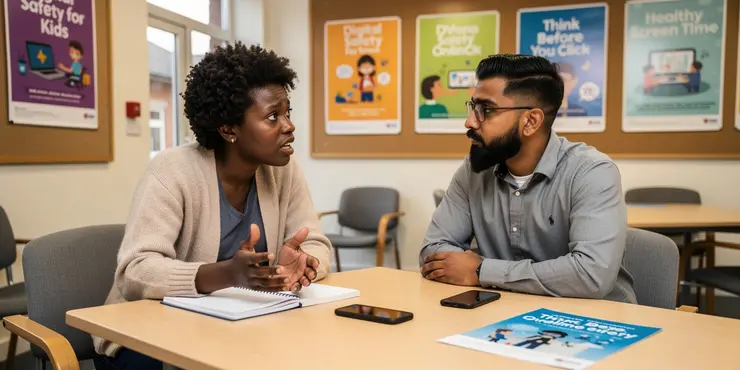

Speak To An Expert
Get clear, personalised advice for your situation.
Jot down a few questions to make the most of your conversation.
Introduction to the Debate
The idea of banning social media for children has sparked a lively debate in the UK. Advocates argue that such a ban could protect children from online harms. Critics, however, present compelling arguments against this approach. Exploring these critiques illuminates the complexities of the issue.
Some believe that a ban oversimplifies the challenges children face online. Others feel it fails to address the root causes of these problems. A nuanced discussion helps in understanding the broader implications of this policy.
Impact on Digital Literacy
Critics point out that banning social media may hinder the development of digital literacy. Children gain vital skills by engaging in online platforms under guided supervision. These skills are essential for navigating today's digital world safely and effectively.
Without exposure to social media, children might lack understanding of online norms and etiquette. This lack of familiarity could leave them vulnerable in future digital interactions. A blanket ban risks depriving them of crucial learning opportunities.
Effect on Social Development
Opponents also highlight concerns about social development. Social media can be a powerful tool for children to express themselves and form connections. Banning these platforms might limit their ability to engage socially and culturally in an increasingly digital society.
Some argue that online interactions foster a sense of community and belonging. For children, especially those with limited social opportunities offline, digital platforms offer avenues to interact and collaborate with peers. Removing access could potentially isolate them further.
Practicality and Enforcement Challenges
Another criticism is the practicality of enforcing a social media ban for children. Technological barriers to monitor and enforce such restrictions are significant. Children are often adept at circumventing age restrictions and using platforms discreetly.
There is also a concern about the invasion of privacy and autonomy. Monitoring children's internet usage too closely may incite a backlash and breach trust. Critics argue that education and support are more effective than stringent controls.
Calls for Alternative Solutions
Critics urge for alternatives to outright bans, emphasizing the importance of education and parental involvement. Digital literacy programs could educate children on safe and responsible online behaviors. Encouraging open communication between parents and children is vital.
Providing resources and support for both parents and educators can equip them to guide children effectively. Empowering children with knowledge and skills is considered a better solution than restricting their online experiences. Addressing broader societal issues is essential for safeguarding children online.
Frequently Asked Questions
Critics argue that such bans may infringe on freedom of expression, limit access to information, and fail to address the root causes of online harm.
Many critics believe that simply banning social media may not be effective, as children might circumvent restrictions or move to less monitored platforms.
Critics suggest that bans might undermine parental responsibility and involvement in teaching children how to use social media safely and responsibly.
It is argued that a ban might push social media use underground, making it harder for parents and educators to monitor and guide children.
Enforcement could be challenging, and it may lead to privacy concerns if it involves monitoring children's online activity.
Yes, critics worry that a ban could prevent children from gaining important digital literacy skills that are crucial in today's digital world.
Some argue that social media can be a tool for social development and creativity, and a ban might hinder these opportunities.
Critics often advocate for alternative solutions, like increased education for both parents and children about safe social media use, rather than outright bans.
There is no consensus among experts on the precise age, leading some to criticize blanket bans for not considering individual maturity and readiness.
Critics argue that age verification systems can be unreliable, invasive, and might pose significant privacy risks for children.
While acknowledging mental health concerns, critics argue that education and better content moderation are more effective than bans, which do not address underlying issues.
Critics highlight potential violations of children's rights to information, expression, and participation in digital spaces.
Critics argue that a ban might disproportionately affect disadvantaged children who have fewer alternate ways to connect, learn, and participate in digital discussions.
Many critics argue that a one-size-fits-all ban does not consider cultural, social, and economic differences across communities and nations.
There is concern that a ban might lead children to use unsupervised and potentially dangerous online spaces that lack adequate safety measures.
Social media is seen by some critics as a valuable educational resource, and a ban might limit educational opportunities and innovative learning methods.
Critics argue that systemic issues like cyberbullying and data privacy are ignored when the focus is solely on banning children’s access.
Yes, some believe that social media can help children develop social skills and a ban might impair these developmental opportunities.
Imposing a ban might send a message that children are incapable of responsible behavior online, which critics argue is an unfair generalization.
Critics worry that preventing children from accessing social media could stifle creativity and innovation, as these platforms often serve as spaces for innovation and expression.

Ergsy Search Results
This website offers general information and is not a substitute for professional advice.
Always seek guidance from qualified professionals.
If you have any medical concerns or need urgent help, contact a healthcare professional or emergency services immediately.
Some of this content was generated with AI assistance. We've done our best to keep it accurate, helpful, and human-friendly.
- Ergsy carefully checks the information in the videos we provide here.
- Videos shown by Youtube after a video has completed, have NOT been reviewed by ERGSY.
- To view, click the arrow in centre of video.
- Most of the videos you find here will have subtitles and/or closed captions available.
- You may need to turn these on, and choose your preferred language.
- Go to the video you'd like to watch.
- If closed captions (CC) are available, settings will be visible on the bottom right of the video player.
- To turn on Captions, click settings.
- To turn off Captions, click settings again.