
Speak To An Expert
Get clear, personalised advice for your situation.
Jot down a few questions to make the most of your conversation.
Understanding the Initial Steps
Arranging a funeral in the UK can seem overwhelming, especially during a time of grief. Breaking it into steps can simplify the process. The first step is crucial, laying the foundation for the entire arrangement.
Starting the arrangement process involves practical decisions and being informed about the needed legal procedures. It requires understanding both emotional and logistical needs.
Contacting a Funeral Director
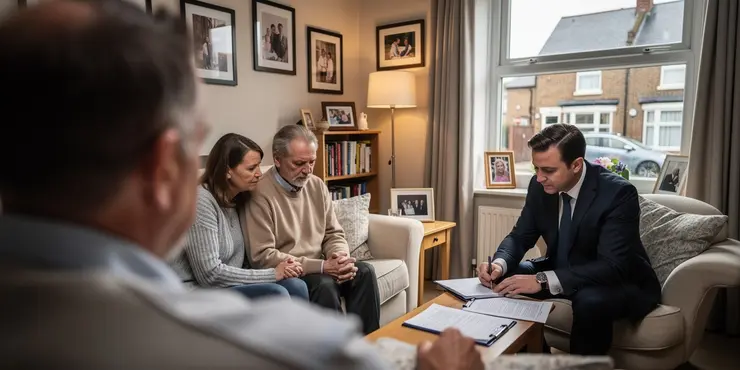
The initial step often involves contacting a funeral director. Funeral directors provide professional support and guidance during this difficult time.
They help coordinate the various aspects of the funeral, from planning the service to handling paperwork. They can also offer advice on personalizing the ceremony to reflect the deceased’s wishes.
Registering the Death
Before most funeral arrangements can be made, it’s mandatory to register the death. This must be done within five days in England, Wales, and Northern Ireland, and within eight days in Scotland.
The registration is performed at the local Register Office, and an official death certificate is issued. This certificate is essential for organizing the funeral and handling the deceased’s legal affairs.
Gathering Necessary Information
During this initial stage, gather essential information about the deceased. This includes details such as their full name, date of birth, and any specific funeral wishes they might have had.
This information will assist the funeral director in planning a respectful service. It also ensures that the arrangements align with any pre-existing plans or the wishes expressed in a will.
Deciding on the Type of Funeral
Consider the type of funeral that best suits the deceased and the family’s preferences. This could be a burial, cremation, or an alternative service.
Discussing these options early helps in making informed decisions. It also provides clarity on what steps the funeral director should prioritize next.
Planning for Immediate Needs
In the immediate aftermath of a death, some decisions need urgent attention. Arranging care for the deceased’s body and understanding any religious or cultural requirements are key.
Ensuring these aspects are considered promptly can alleviate further stress. It allows the family to focus on coming together for support and remembrance.
Frequently Asked Questions
The first step is to obtain a medical certificate of the cause of death from a doctor.
A doctor who attended to the deceased issues the medical certificate of cause of death.
The medical certificate is needed to legally register the death and proceed with funeral arrangements.
After obtaining the certificate, you should register the death with the local register office.
No, you must have the medical certificate to register the death and legally arrange a funeral.
You can discuss plans with a funeral director, but official arrangements require the death to be registered.
The next of kin or another close family member typically obtains the medical certificate.
It should be obtained as soon as possible, typically within 24 hours of the death.
You will need details about the deceased, such as their full name, date of birth, and address.
Yes, a funeral director can provide guidance but cannot obtain the certificate on your behalf.
Yes, it is used to formally register the death at the local registry office.
No, deaths must be registered in person at a local register office.
The hospital will usually assist in facilitating the issuance of the medical certificate.
If the death is sudden or unexplained, it may be referred to a coroner, who will investigate before a certificate is issued.
You provide the medical certificate and some personal details about the deceased person to register the death.
After registration, a 'death certificate' allows the funeral plans to officially proceed.
The next of kin, a relative, or someone who was present at the death can register it.
You usually receive the death certificate immediately after registration is complete.
A death certificate is needed to legally confirm the death before final funeral arrangements.
You can obtain a replacement copy from the registry office where the death was registered.

Ergsy Search Results
This website offers general information and is not a substitute for professional advice.
Always seek guidance from qualified professionals.
If you have any medical concerns or need urgent help, contact a healthcare professional or emergency services immediately.
Some of this content was generated with AI assistance. We've done our best to keep it accurate, helpful, and human-friendly.
- Ergsy carefully checks the information in the videos we provide here.
- Videos shown by Youtube after a video has completed, have NOT been reviewed by ERGSY.
- To view, click the arrow in centre of video.
- Most of the videos you find here will have subtitles and/or closed captions available.
- You may need to turn these on, and choose your preferred language.
- Go to the video you'd like to watch.
- If closed captions (CC) are available, settings will be visible on the bottom right of the video player.
- To turn on Captions, click settings.
- To turn off Captions, click settings again.