
Get Answers
Introduction to Ashes Return
In the UK, the process of returning ashes to the family is handled with care and respect. After cremation, the ashes are placed in a temporary container for transport.
This sensitive task is typically guided by the family’s wishes and any pre-decided plans with the funeral director. Understanding the process can provide peace of mind during a difficult time.
The Cremation Process
Once cremation is complete, the remains are cooled and processed to remove any larger fragments. These are further reduced to fine ashes for uniformity.
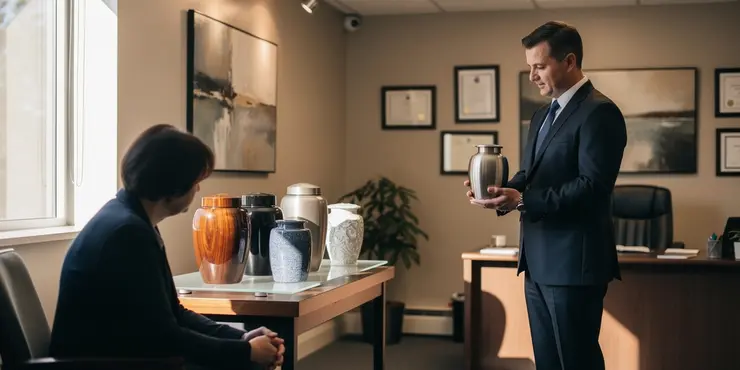
The ashes are then placed in a secure container. Families are typically presented with a choice of temporary or more permanent urns at this stage.
Choosing an Urn
Families often select from a range of urns to hold the ashes. Options vary from simple, functional designs to more elaborate creations.
The urn choice often depends on the planned final resting place for the ashes, whether that’s a family home, a garden, or another special location.
Collection and Delivery
Once prepared, families can usually collect the ashes directly from the crematorium or funeral director. Some services also offer delivery to a specified location.
It is important for families to liaise with the crematorium or funeral service provider to arrange a suitable collection or delivery time.
Legal and Formal Considerations
In the UK, crematoria are regulated to ensure the respectful handling of ashes. Families should be provided with a certificate of cremation upon collection.
This certificate is essential for record-keeping and may be required for any future memorial or legal purposes.
Personalising the Ashes Return
Some families choose to hold a small ceremony when ashes are returned. This occasion can provide an opportunity for loved ones to gather and reflect.
Other times, ashes are integrated into memorial items such as jewellery. This offers a personalised way to keep memories close.
Conclusion
The return of ashes to family members is an important step in the grieving process. Handling this with sensitivity can help family members feel more connected and comforted.
By understanding the process, families can make informed decisions that honour their loved ones, provide them with solace, and respect cultural or personal traditions.
Frequently Asked Questions
Ashes are typically returned to the family in a sealed, temporary container, unless a permanent urn was chosen in advance.
Yes, families can choose from a variety of urns and containers offered by the crematorium or funeral home.
Ashes are usually returned to the family within a week after the cremation process is complete.
Yes, a family member or authorized representative usually needs to provide identification and a copy of the death certificate to collect the ashes.
Yes, ashes can be legally shipped, though there are regulations and specific guidelines that must be followed.
Some funeral homes offer delivery services for ashes, either personally or via courier services.
Families can choose from a variety of urns, keepsakes, or other decorative vessels to store ashes at home.
Families should check local laws and regulations regarding scattering ashes and choose a meaningful location for the ceremony.
Yes, ashes can be divided and placed into smaller urns or keepsakes for distribution among family members.
Yes, many services specialize in creating jewelry, artwork, or memorial objects containing a portion of the ashes.
Temporary containers are often made from durable materials like plastic or cardboard.
Yes, the deceased’s executor or a person designated in writing can be assigned to receive the ashes.
Families can either transfer the ashes themselves or have the funeral home assist with the transfer into a chosen urn.
Any potential fees depend on the service chosen by the family, such as urn upgrades or shipping costs.
When shipped, ashes are securely packaged in a sealed container, often placed within a larger box, with care taken to comply with postal and custom regulations.
Only individuals authorized by the family, often requiring written consent, can pick up the ashes.
Most crematoriums can store ashes for a limited time, but arrangements should be confirmed in advance.
Typically, a basic temporary container is included, but upgraded urns may incur additional costs.
No, the cremation process is designed to ensure that ashes are kept separate for each individual.
Unclaimed ashes are usually held by the crematorium for a specified period before being respectfully interred, scattered, or otherwise dealt with according to local law.

Ergsy Search Results
This website offers general information and is not a substitute for professional advice.
Always seek guidance from qualified professionals.
If you have any medical concerns or need urgent help, contact a healthcare professional or emergency services immediately.
Some of this content was generated with AI assistance. We've done our best to keep it accurate, helpful, and human-friendly.
- Ergsy carefully checks the information in the videos we provide here.
- Videos shown by Youtube after a video has completed, have NOT been reviewed by ERGSY.
- To view, click the arrow in centre of video.
- Most of the videos you find here will have subtitles and/or closed captions available.
- You may need to turn these on, and choose your preferred language.
- Go to the video you'd like to watch.
- If closed captions (CC) are available, settings will be visible on the bottom right of the video player.
- To turn on Captions, click settings.
- To turn off Captions, click settings again.