
Speak To An Expert
Get clear, personalised advice for your situation.
Jot down a few questions to make the most of your conversation.
Help from the NHS
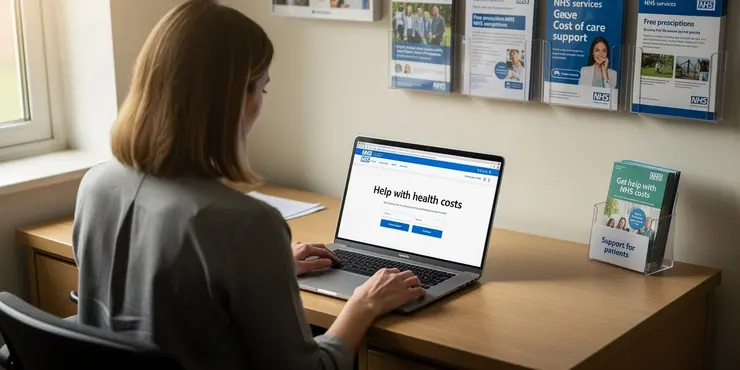
If you need support with health costs, the NHS is often the best place to start. In England, many people on a low income may be able to get help with prescriptions, dental treatment, eye tests and travel to NHS appointments.
The NHS Low Income Scheme can reduce or remove some charges if your earnings and savings are below a certain level. You can apply online or by post, and you may receive a certificate that shows what help you are entitled to.
Check if you qualify for free help
You may already qualify for support because of the benefits you receive. For example, people getting Universal Credit, Pension Credit Guarantee Credit, Income Support, income-based Jobseeker’s Allowance, or income-related Employment and Support Allowance may be entitled to free or reduced NHS charges.
Rules can change depending on where you live in the UK. Scotland, Wales and Northern Ireland each have their own systems, so it is worth checking the relevant NHS website for local support and eligibility details.
Ask your local council
Your local council may be able to help if health costs are causing hardship. Some councils offer welfare support, discretionary payments or local assistance schemes for residents in financial difficulty.
You can also ask about help with transport to medical appointments, social care charges, or support linked to disability and long-term illness. Councils often have advice teams that can point you towards other grants or services.
Use charities and condition-specific support
Many charities offer grants, advice or practical help with health-related expenses. This can include help with treatment costs, travel, equipment, wigs, hospital parking or extra living costs linked to an illness.
Large national charities such as Macmillan Cancer Support, Marie Curie, Turn2us and Citizens Advice can help you find grants and check what you may be entitled to. Smaller charities linked to specific conditions may also offer one-off payments.
Get help with travel and prescriptions
If you travel frequently for treatment, you may be able to claim back some transport costs through the NHS Healthcare Travel Costs Scheme. This usually applies if you receive certain benefits and need to attend eligible NHS appointments.
Prescription costs can also be reduced through prepayment certificates, which may save money if you need regular medicines. If you are unsure whether you qualify for free prescriptions, check the latest NHS guidance before paying.
Where to get advice
If you are not sure what support you can get, Citizens Advice is a good place to ask. They can help you understand NHS charges, benefit entitlement and how to apply for financial help.
You can also speak to your GP surgery, hospital finance team or hospital social worker. They may know about local schemes and can sometimes help you complete forms or direct you to the right support.
Frequently Asked Questions
You can start with your health insurance provider, employer benefits team, local social services, community health centers, and patient assistance programs offered by hospitals or drug manufacturers.
Start by contacting the billing department of the hospital, clinic, or doctor’s office to ask about financial assistance, payment plans, or charity care options.
Yes, your insurer can explain covered services, in-network providers, prior authorization rules, and appeal options that may help reduce your costs.
Yes, programs such as Medicaid, CHIP, Medicare savings programs, and local assistance programs may help depending on your income, age, and situation.
You can check manufacturer assistance programs, pharmacy discount programs, nonprofit foundations, and state or federal medication assistance resources.
Many hospitals offer charity care or sliding-scale discounts based on income and household size, so ask the hospital’s financial assistance office.
Yes, community health centers often provide care on a sliding fee scale and may offer primary care, dental, mental health, and preventive services at reduced rates.
Ask your doctor, hospital, or clinic to connect you with a medical social worker or patient navigator who can help locate financial resources.
Contact the billing office and request an itemized bill, explanation of charges, and help reviewing possible errors or duplicate charges.
Yes, many nonprofits offer grants, emergency assistance, transportation help, lodging support, or direct help with copays and treatment costs.
Check your insurer, local community mental health centers, employee assistance programs, and nonprofit counseling services that offer reduced-fee care.
Yes, dental schools, community clinics, nonprofit dental programs, and some public health departments provide low-cost or sliding-scale dental services.
Yes, many providers offer interest-free payment plans or flexible arrangements if you contact them before bills go to collections.
Patient advocacy groups, disease-specific foundations, insurance case managers, and specialty pharmacies may offer financial assistance and cost-saving guidance.
Seniors can check Medicare counseling services, State Health Insurance Assistance Programs, Medicaid, Extra Help for prescriptions, and local aging agencies.
Reach out to hospital financial counselors, local charities, community clinics, and emergency assistance funds as soon as possible after receiving care.
Your employer may offer health savings accounts, flexible spending accounts, wellness benefits, employee assistance programs, or access to benefits advisers.
Families can check CHIP, Medicaid, pediatric hospital assistance programs, school-based health centers, and nonprofit children’s health organizations.
Yes, some insurance plans, local nonprofits, hospitals, and public health agencies offer transportation vouchers, ride services, or mileage reimbursement.
Call 211, visit your local health department, contact community clinics, or ask a hospital patient advocate for a list of nearby financial assistance resources.

Ergsy Search Results
This website offers general information and is not a substitute for professional advice.
Always seek guidance from qualified professionals.
If you have any medical concerns or need urgent help, contact a healthcare professional or emergency services immediately.
Some of this content was generated with AI assistance. We've done our best to keep it accurate, helpful, and human-friendly.
- Ergsy carefully checks the information in the videos we provide here.
- Videos shown by Youtube after a video has completed, have NOT been reviewed by ERGSY.
- To view, click the arrow in centre of video.
- Most of the videos you find here will have subtitles and/or closed captions available.
- You may need to turn these on, and choose your preferred language.
- Go to the video you'd like to watch.
- If closed captions (CC) are available, settings will be visible on the bottom right of the video player.
- To turn on Captions, click settings.
- To turn off Captions, click settings again.