
Get Answers
Why tax credits and incentives matter
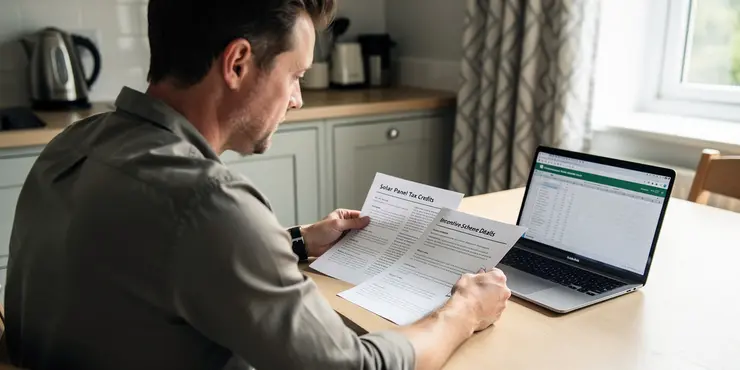
Solar panels can be a major upfront investment, so it is sensible to ask what financial support is available before you buy. In the UK, the rules around incentives can affect how quickly your system pays for itself.
Even when there is no single national “tax credit” for domestic solar, there may still be savings through VAT rules, export payments, local schemes, or business tax reliefs. Knowing what applies to your property helps you compare installers on a like-for-like basis.
Questions to ask about VAT and purchase costs
Ask whether the quote includes VAT and, if so, what rate applies to your installation. For some domestic energy-saving materials, VAT relief may reduce the cost, but you should confirm how this is applied to panels, batteries, and associated works.
It is also worth asking whether the installer has already included scaffolding, wiring, inverters, and planning-related costs in the final price. A low headline price can become expensive if those items are added later.
Questions to ask about export payments and energy schemes
Ask whether your system can earn money through the Smart Export Guarantee, often called the SEG. This scheme pays you for electricity you export back to the grid, but rates vary by supplier.
You should also ask which suppliers currently offer export tariffs and whether the installer can help you set up the export meter correctly. If you plan to add a battery, ask how that might affect your export earnings and payback period.
Questions to ask if you are a business owner or landlord
If the property is commercial, ask what capital allowances or business tax deductions may apply. Solar panel installations on business premises can sometimes qualify for tax relief, which may improve the overall return.
Landlords should ask whether the installation affects rental income, property value, or any tax reporting obligations. It is wise to confirm with an accountant how the system should be treated for your specific tax position.
Questions to ask about local grants and eligibility
Ask whether any local authority grants, community energy schemes, or regional funding streams are available in your area. Some support is limited, time-sensitive, or targeted at certain households, so eligibility matters.
You should also ask whether you need to apply before work starts. Many schemes require approval in advance, and missing that step can mean losing the incentive.
Questions to ask before you sign
Ask the installer to provide a written breakdown of all incentives they have assumed in the quote. This should include any VAT treatment, export income estimates, and expected savings calculations.
Finally, ask what happens if a scheme changes after you place your order. Clear answers will help you understand the true cost, the likely payback time, and whether the installation still makes financial sense.
Frequently Asked Questions
The solar panel installation tax credit and incentive questions for homeowners usually center on the federal Residential Clean Energy Credit and any available state, local, utility, or financing incentives that can reduce the cost of a solar installation.
Eligibility for solar panel installation tax credit and incentive questions typically depends on whether you own the property, whether the system is new and installed on an eligible primary or secondary residence, and whether you have enough tax liability to use the credit.
Savings from solar panel installation tax credit and incentive questions can vary widely, but federal credits, state rebates, local programs, and reduced electric bills can together lower the total cost significantly.
The federal solar panel installation tax credit and incentive questions are generally answered by the Residential Clean Energy Credit, which lets qualifying homeowners claim a percentage of eligible solar installation costs on their federal tax return.
Solar panel installation tax credit and incentive questions usually include equipment, labor, wiring, mounting hardware, inverters, permit fees, inspection costs, and certain related electrical upgrades if they are part of the solar system.
Battery storage often qualifies under solar panel installation tax credit and incentive questions if it meets federal requirements and is charged by a solar energy system, though program rules can differ by location and tax year.
Yes, solar panel installation tax credit and incentive questions may apply to a second home if it is located in the United States and meets the program’s eligibility rules, but it generally cannot be claimed for rental property you do not live in.
Renters usually cannot claim solar panel installation tax credit and incentive questions for a system installed on property they do not own, though they may benefit indirectly if a landlord installs solar or if a community solar program offers savings.
To apply for solar panel installation tax credit and incentive questions, you normally keep all receipts and documentation, then claim the credit on your federal tax return and separately apply for any state, utility, or rebate programs that require their own forms.
Documentation for solar panel installation tax credit and incentive questions usually includes invoices, proof of payment, manufacturer information, permit records, interconnection paperwork, and any forms required by the tax authority or incentive administrator.
Leased systems generally do not allow the homeowner to claim solar panel installation tax credit and incentive questions because the system owner is often the leasing company, although lease payments may still offer predictable energy savings.
Power purchase agreements typically do not let the customer claim solar panel installation tax credit and incentive questions because a third party owns the equipment, but the arrangement may still lower monthly electricity costs.
In many cases, you can combine rebates with solar panel installation tax credit and incentive questions, but rebates may reduce the tax credit basis, so it is important to check the rules for each incentive program.
State programs can greatly affect solar panel installation tax credit and incentive questions by adding rebates, credits, sales tax exemptions, property tax exemptions, or performance-based payments that stack with federal incentives.
Solar panel installation tax credit and incentive questions may be available for new construction if the solar system is installed on an eligible residence and the ownership, service date, and tax rules are satisfied.
If you do not have enough tax liability for solar panel installation tax credit and incentive questions, you may not be able to use the full credit in one year, but some tax credits may be carried forward depending on the applicable rules.
Solar panel installation tax credit and incentive questions usually do not cover a full roof replacement, but certain roof repair or structural work may qualify if it is directly necessary for the solar installation and allowed by the program.
A DIY solar installation may qualify for some solar panel installation tax credit and incentive questions if it meets program requirements, but only eligible costs and properly documented components are typically countable, and labor rules may differ.
Solar panel installation tax credit and incentive questions can be processed on different timelines: the federal tax credit is claimed when you file taxes, while rebates and utility incentives may take weeks or months to be approved and paid.
Current solar panel installation tax credit and incentive questions rules are usually found on the IRS website, your state energy office website, local utility program pages, and official incentive administrator materials.

Ergsy Search Results
This website offers general information and is not a substitute for professional advice.
Always seek guidance from qualified professionals.
If you have any medical concerns or need urgent help, contact a healthcare professional or emergency services immediately.
Some of this content was generated with AI assistance. We've done our best to keep it accurate, helpful, and human-friendly.
- Ergsy carefully checks the information in the videos we provide here.
- Videos shown by Youtube after a video has completed, have NOT been reviewed by ERGSY.
- To view, click the arrow in centre of video.
- Most of the videos you find here will have subtitles and/or closed captions available.
- You may need to turn these on, and choose your preferred language.
- Go to the video you'd like to watch.
- If closed captions (CC) are available, settings will be visible on the bottom right of the video player.
- To turn on Captions, click settings.
- To turn off Captions, click settings again.