
Get Answers
Medical Support
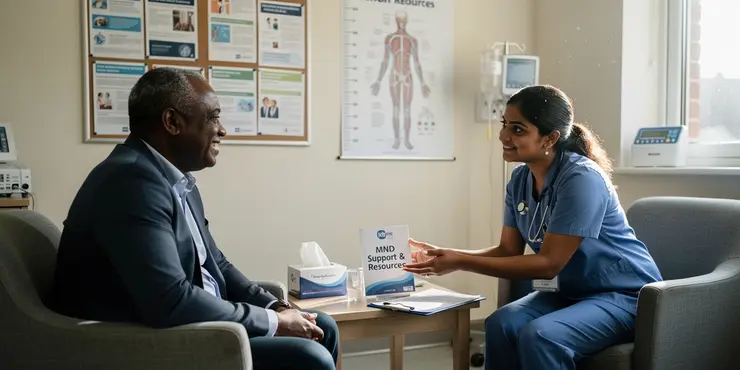
For those living with Motor Neurone Disease (MND) in the UK, medical support is crucial. The NHS provides access to specialists, such as neurologists, who can help manage symptoms and progression.
Regular visits to healthcare professionals allow for monitoring and adjustments in treatment plans. GPs also play a key role in coordinating care and providing referrals to other health services.
Specialist MND clinics offer comprehensive care. These clinics amalgamate the expertise of multiple healthcare providers, offering a one-stop solution for patients.
Therapies and Rehabilitation
People with MND benefit from various therapies that help maintain quality of life. Physiotherapy is often recommended to preserve mobility and manage pain.
Occupational therapy aids in adapting homes and workplaces to meet changing physical needs. Speech and language therapists assist with communication challenges that may arise as the disease progresses.
Nutritional advice is vital for those experiencing difficulties with eating and swallowing. Dietitians provide guidance on managing these issues effectively.
Emotional and Psychological Support
Dealing with MND can be emotionally challenging. Support groups offer a space for patients to share experiences and gain encouragement from others facing similar situations.
Counselling services are available to help individuals and their families cope with the emotional aspects of the disease. Many organizations provide helplines staffed by trained counsellors.
Mental health professionals can provide therapeutic support, helping to address issues such as anxiety and depression. Finding the right emotional support can significantly improve overall wellbeing.
Financial and Legal Assistance
Financial concerns are common for those living with MND. Various benefits and allowances can provide financial relief, such as Personal Independence Payment (PIP) and Employment and Support Allowance (ESA).
The MND Association offers information on navigating the benefits system and can assist in making claims. Legal advice is also essential to address employment rights and future planning.
Setting up a Power of Attorney and creating an advance directive are recommended steps. These legal tools ensure that individuals’ wishes are respected as circumstances change.
Community and Charitable Support
Several charities in the UK focus on supporting people with MND and their families. The MND Association is a key charity, offering a range of services including research, advocacy, and support.
Local support groups provide community connections and host meetings that inspire social interaction and mutual support. These groups are valuable for reducing feelings of isolation.
Fundraising and awareness campaigns run by charities also help to promote understanding of the disease and raise much-needed funds for research and support services.
Frequently Asked Questions
Motor Neuron Disease (MND) is a progressive neurological condition that affects the motor neurons, the cells that control voluntary muscle activity such as speaking, walking, swallowing, and breathing.
Medical support for people with MND includes regular consultations with neurologists, respiratory therapists, occupational therapists, physical therapists, and speech and language therapists to manage symptoms and improve quality of life.
Yes, many hospitals have specialized MND clinics that offer a multidisciplinary approach to treatment and care, bringing together various specialists to provide comprehensive support.
Occupational therapy helps people with MND maintain independence by suggesting adaptive equipment, modifying the home environment, and teaching techniques to perform daily living activities more easily.
Yes, people with MND may be eligible for benefits and financial assistance programs such as disability benefits, grants for home modifications, and support from charitable organizations.
Palliative care focuses on providing relief from the symptoms and stress of MND. It aims to improve quality of life for both the patient and their family, often involving pain management and emotional support.
Yes, speech therapy can assist individuals with MND in maintaining their ability to communicate for as long as possible, and can introduce alternative communication methods when necessary.
Yes, there are numerous support groups for people with MND and their families, providing a space to share experiences, offer support, and learn more about managing the condition.
Dietitians can provide nutritional support by suggesting meal plans and dietary changes to ensure individuals with MND receive adequate nutrition, especially if swallowing difficulties present.
Yes, psychological support such as counseling or therapy can be very beneficial for people with MND and their families to help cope with emotional and psychological challenges.
Research on MND is focused on understanding the causes, finding treatments, and exploring potential cures. This includes studies on genetics, disease mechanisms, and new therapeutic approaches.
Yes, respite care services are available to provide temporary relief for carers of people with MND, allowing them to take a break while ensuring the person with MND receives quality care.
Physical therapy helps maintain mobility and muscle strength, manage pain, and prevent complications such as joint stiffness, which are common in MND patients.
Charities provide a range of services including support groups, information, funding for research, financial assistance, and advocacy for people with MND and their families.
Some people with MND find alternative therapies such as acupuncture, massage, or relaxation techniques helpful for symptom management and overall well-being, though these should be discussed with healthcare providers.
Yes, many organizations offer online resources including forums, webinars, informational guides, and virtual support groups for people with MND and their families.
Assistive technology such as communication devices, mobility aids, and specialized software can help people with MND maintain independence and improve their quality of life.
Family members can provide emotional support, assist with daily activities, educate themselves about the condition, and encourage their loved one to engage with available support services.
Genetics can play a role in MND, as some forms of the disease are inherited. Genetic counseling and testing may be available for those with a family history of MND.
Early intervention is vital as it allows for timely management of symptoms, improving the quality of life and potentially slowing progression with therapies and lifestyle adjustments.

Ergsy Search Results
This website offers general information and is not a substitute for professional advice.
Always seek guidance from qualified professionals.
If you have any medical concerns or need urgent help, contact a healthcare professional or emergency services immediately.
Some of this content was generated with AI assistance. We've done our best to keep it accurate, helpful, and human-friendly.
- Ergsy carefully checks the information in the videos we provide here.
- Videos shown by Youtube after a video has completed, have NOT been reviewed by ERGSY.
- To view, click the arrow in centre of video.
- Most of the videos you find here will have subtitles and/or closed captions available.
- You may need to turn these on, and choose your preferred language.
- Go to the video you'd like to watch.
- If closed captions (CC) are available, settings will be visible on the bottom right of the video player.
- To turn on Captions, click settings.
- To turn off Captions, click settings again.