
Get Answers
What is an mRNA vaccine?
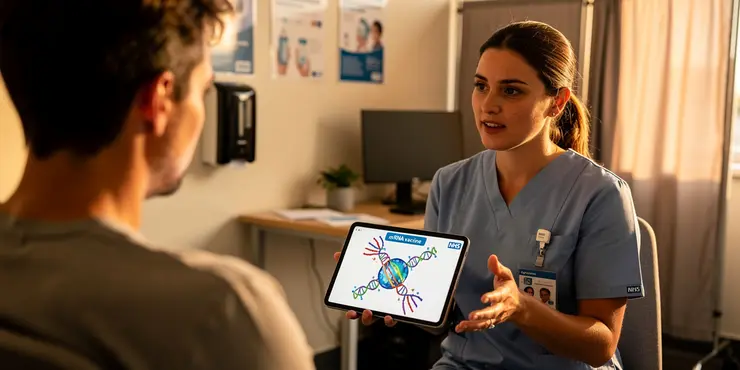
An mRNA vaccine is a type of vaccine that teaches your body how to recognise a virus. It uses messenger RNA, often shortened to mRNA, which carries instructions to your cells. These instructions tell your cells to make a harmless piece of a virus, not the whole virus itself.
Your immune system then notices this piece and learns to respond to it. If you later come into contact with the real virus, your body is better prepared to fight it off. This helps reduce the risk of getting seriously ill.
How does it work?
After an mRNA vaccine is given, the mRNA enters some of your cells. The cells use the instructions to make a small protein found on the virus surface. This protein cannot cause the disease on its own.
Your immune system sees the protein as foreign and starts making antibodies and other protective responses. It also creates immune memory, which helps your body react faster in future. The mRNA does not stay in the body for long.
What makes it different from other vaccines?
Traditional vaccines often use weakened or inactive versions of a virus, or a small part of it. mRNA vaccines work differently because they give your cells the genetic instructions to make the viral protein themselves. This is a newer approach, but the basic science has been studied for many years.
One advantage is that mRNA vaccines can be developed relatively quickly once scientists know the target virus. They can also be adapted more easily if the virus changes. This made them especially important during the COVID-19 pandemic.
Are mRNA vaccines safe?
mRNA vaccines used in the UK have gone through strict testing and approval. Like all medicines, they can cause side effects, but these are usually mild and short-lived. Common side effects include a sore arm, tiredness, headache, or a mild fever.
Serious side effects are rare. The benefits of vaccination, especially against serious illness and complications, are weighed carefully against any risks. If you are unsure, you can speak to a GP, pharmacist, or nurse.
Why are they used?
mRNA vaccines help protect people against infectious diseases. They became well known through the COVID-19 vaccines, but researchers are also studying them for other illnesses. These include flu, RSV, and some cancers.
For many people, mRNA vaccines offer an effective way to build protection without being exposed to the full virus. They are now an important part of modern vaccine science. For UK patients, they are another tool to help prevent serious disease and protect public health.
Frequently Asked Questions
An mRNA vaccine is a type of vaccine that uses messenger RNA to instruct cells to make a harmless piece of a target protein, which helps the immune system recognize and respond to it.
An mRNA vaccine delivers genetic instructions into some cells so they can temporarily make a protein fragment that trains the immune system to build antibodies and immune memory.
mRNA vaccines have been used to help prevent diseases such as COVID-19, and the platform is being studied for other infectious diseases and some cancers.
mRNA vaccines contain carefully tested ingredients such as the mRNA itself, lipids that protect it, salts, and sugars. These ingredients are selected for safety and effectiveness.
No, an mRNA vaccine does not change your DNA. The mRNA stays outside the cell nucleus and is broken down by the body after it delivers its instructions.
Common side effects of an mRNA vaccine include pain at the injection site, fatigue, headache, muscle aches, chills, and mild fever. These usually go away within a few days.
Protection from an mRNA vaccine can decrease over time, especially against infection, which is why boosters may be recommended depending on the disease and public health guidance.
Eligibility for an mRNA vaccine depends on the specific vaccine, age, health status, and local recommendations. A healthcare provider or public health authority can help determine eligibility.
Pregnant people may be eligible for an mRNA vaccine depending on the vaccine and current medical guidance. In many cases, vaccination is recommended because the benefits may outweigh the risks.
Some mRNA vaccines are authorized or approved for children in specific age groups. The appropriate age range depends on the vaccine and local regulatory guidance.
The number of doses for an mRNA vaccine depends on the product and the disease it targets. Some regimens require a primary series plus booster doses.
An mRNA vaccine can sometimes be given at the same visit as other vaccines, but timing and injection site recommendations may vary. A healthcare professional can advise on the best schedule.
Before receiving an mRNA vaccine, review your allergies, current illnesses, medications, and prior vaccine reactions with a healthcare provider and follow the vaccination site instructions.
After receiving an mRNA vaccine, you should stay for the recommended observation period, watch for side effects, and seek medical help if you develop symptoms of a severe allergic reaction.
An mRNA vaccine can be highly effective at preventing severe disease, hospitalization, and death, though effectiveness against infection may vary by variant, time since vaccination, and other factors.
No, an mRNA vaccine cannot cause the infection it is designed to prevent because it does not contain live virus or bacteria.
An mRNA vaccine gives cells instructions to make a protein target, while traditional vaccines may use weakened pathogens, inactivated pathogens, protein subunits, or toxoids to train immunity.
Many mRNA vaccines require cold storage because the mRNA is fragile and can break down if not kept at the correct temperature. Storage requirements vary by product.
Yes, someone may still benefit from an mRNA vaccine after a previous infection because vaccination can strengthen and broaden immune protection. Timing may depend on medical guidance.
Someone should seek medical help after an mRNA vaccine if they have trouble breathing, swelling of the face or throat, chest pain, fainting, severe dizziness, or other signs of a serious reaction.

Ergsy Search Results
This website offers general information and is not a substitute for professional advice.
Always seek guidance from qualified professionals.
If you have any medical concerns or need urgent help, contact a healthcare professional or emergency services immediately.
Some of this content was generated with AI assistance. We've done our best to keep it accurate, helpful, and human-friendly.
- Ergsy carefully checks the information in the videos we provide here.
- Videos shown by Youtube after a video has completed, have NOT been reviewed by ERGSY.
- To view, click the arrow in centre of video.
- Most of the videos you find here will have subtitles and/or closed captions available.
- You may need to turn these on, and choose your preferred language.
- Go to the video you'd like to watch.
- If closed captions (CC) are available, settings will be visible on the bottom right of the video player.
- To turn on Captions, click settings.
- To turn off Captions, click settings again.