
Get Answers
Regular Visual Checks
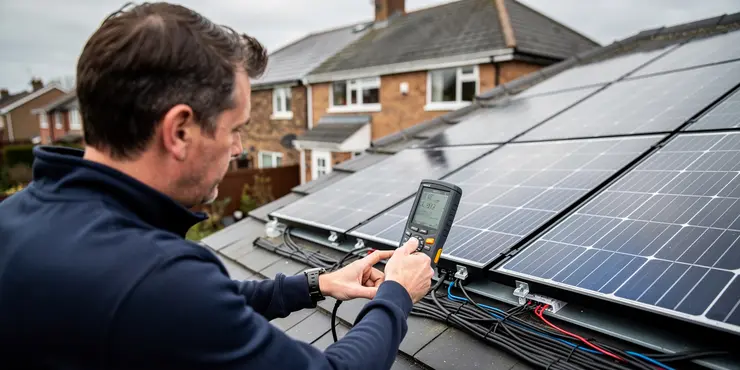
Monitoring duties begin with routine visual inspections of the solar panels, mounting system and visible cabling. For UK properties, this is especially useful after strong winds, heavy rain or snowfall, which can loosen fixings or cause debris build-up.
It is important to look for cracked glass, discoloration, bird droppings, shading from overgrown branches and any signs of water ingress. Early spotting of these issues helps prevent a drop in performance and avoids more costly repairs later.
Performance Monitoring
A key part of solar panel maintenance is checking how much electricity the system is producing. Most modern systems include an inverter display or online monitoring portal that shows daily, weekly and monthly output.
Sudden drops in generation can indicate dirty panels, inverter faults, wiring problems or a damaged module. Regularly comparing current output with expected performance helps identify issues before they become serious.
Inverter and System Alerts
The inverter is one of the most important components to monitor because it converts solar energy into usable electricity. If the inverter shows warning lights, error codes or unusual behaviour, it should be investigated promptly.
Many systems now send alerts by app or email, making it easier to track faults. These notifications are useful for UK homeowners and businesses because they can highlight problems even when the system is not being checked in person.
Cleaning and Dirt Build-Up
Monitoring also includes watching for dirt, moss, leaves and other debris that can reduce panel efficiency. In the UK, pollution, pollen and frequent rainfall can still leave a film on the glass, especially in rural or roadside locations.
Panels do not always need frequent cleaning, but they should be checked to see whether dirt is affecting output. If so, cleaning should be carried out safely and in line with the manufacturer’s guidance.
Safety and Electrical Condition
Another important duty is checking that the system remains safe and secure. This includes monitoring exposed cabling, isolators, mounting brackets and surrounding areas for signs of wear, corrosion or damage.
Any unusual smells, heat, buzzing sounds or tripped circuits should be treated seriously. A qualified solar engineer or electrician should inspect electrical faults, as these can affect both system efficiency and safety.
Record Keeping and Professional Inspections
Keeping a simple maintenance record is part of good monitoring practice. Notes on inspections, output levels, cleaning and repairs make it easier to spot patterns and prove the system has been looked after properly.
In addition to regular owner checks, professional inspections may be needed at intervals recommended by the installer or manufacturer. This helps ensure the system continues to meet expected performance and safety standards over time.
Frequently Asked Questions
Solar panel maintenance monitoring duties are the ongoing tasks used to track system performance, identify faults, schedule upkeep, and ensure solar panels operate safely and efficiently.
Solar panel maintenance monitoring duties are usually handled by facility managers, solar technicians, operations teams, or third-party service providers depending on the size and ownership of the system.
Solar panel maintenance monitoring duties are important because they help detect underperformance early, reduce downtime, protect equipment, extend system life, and maintain energy production.
Daily solar panel maintenance monitoring duties often include checking performance dashboards, reviewing alerts, confirming inverter status, and looking for signs of unusual output or system faults.
Weekly solar panel maintenance monitoring duties may include comparing generation data, reviewing weather-related impacts, checking communication equipment, and noting any recurring alarms or drops in output.
Monthly solar panel maintenance monitoring duties often include detailed performance analysis, inspection of trends, verification of meter readings, and coordination of corrective maintenance if needed.
Solar panel maintenance monitoring duties identify performance issues by comparing expected and actual output, watching for error codes, monitoring temperature and voltage data, and flagging abnormal patterns.
Solar panel maintenance monitoring duties commonly use monitoring software, inverter portals, string monitors, weather stations, mobile inspection apps, and data loggers to track system conditions.
Solar panel maintenance monitoring duties support preventive maintenance by revealing early warning signs such as declining output, communication loss, or equipment instability before major failures occur.
Solar panel maintenance monitoring duties should track inverter faults, ground faults, communication failures, overtemperature alerts, low production warnings, and grid connection issues.
Weather conditions affect solar panel maintenance monitoring duties because cloud cover, dust, rain, heat, wind, and storms can change output and may also create maintenance risks.
Solar panel maintenance monitoring duties include safety checks such as confirming electrical alarms are addressed, identifying damaged components, and ensuring only qualified staff handle hazardous repairs.
Solar panel maintenance monitoring duties should be performed continuously through automated systems, with regular human review daily, weekly, monthly, and after severe weather or fault events.
Solar panel maintenance monitoring duties improve energy production by keeping the system operating near expected levels, minimizing losses from faults, and ensuring issues are resolved quickly.
Solar panel maintenance monitoring duties usually keep records of production data, alarm history, inspection notes, repair actions, component replacements, and service dates for reporting and compliance.
Solar panel maintenance monitoring duties help with cleaning schedules by showing when soiling or dust buildup is reducing output enough to justify panel cleaning.
Inverters are central to solar panel maintenance monitoring duties because they convert power and provide many of the performance and fault signals used to assess system health.
Solar panel maintenance monitoring duties handle shading problems by identifying reduced string performance, checking for new obstructions, and recommending trimming, repositioning, or layout adjustments.
Solar panel maintenance monitoring duties support troubleshooting by narrowing down where a fault is occurring, whether in panels, wiring, inverters, communications, or external conditions.
Common challenges in solar panel maintenance monitoring duties include false alarms, incomplete data, communication outages, weather-related fluctuations, hard-to-access equipment, and delayed repairs.

Ergsy Search Results
This website offers general information and is not a substitute for professional advice.
Always seek guidance from qualified professionals.
If you have any medical concerns or need urgent help, contact a healthcare professional or emergency services immediately.
Some of this content was generated with AI assistance. We've done our best to keep it accurate, helpful, and human-friendly.
- Ergsy carefully checks the information in the videos we provide here.
- Videos shown by Youtube after a video has completed, have NOT been reviewed by ERGSY.
- To view, click the arrow in centre of video.
- Most of the videos you find here will have subtitles and/or closed captions available.
- You may need to turn these on, and choose your preferred language.
- Go to the video you'd like to watch.
- If closed captions (CC) are available, settings will be visible on the bottom right of the video player.
- To turn on Captions, click settings.
- To turn off Captions, click settings again.