
Speak To An Expert
Get clear, personalised advice for your situation.
Jot down a few questions to make the most of your conversation.
Understanding Food Banks
Food banks are vital resources offering assistance to individuals and families who are struggling to afford basic necessities in the UK. They provide free food parcels containing essential items such as canned goods, pasta, rice, and sometimes personal care products. Accessing a food bank can be a straightforward process, but it often requires some initial information and steps.
Eligibility Criteria
Each food bank may have its own criteria for eligibility. Generally, food banks aim to assist those facing financial difficulties or crises. These can include unexpected unemployment, benefits delays, or sudden expenses. In many cases, potential users must demonstrate that they lack the financial means to purchase necessary food supplies.
Referral Process
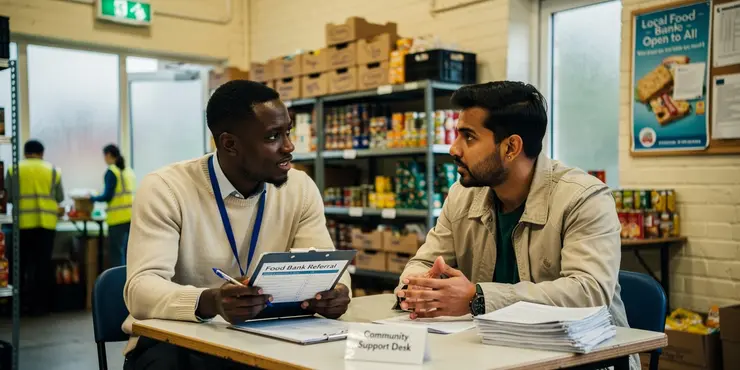
In the UK, it is common for food banks to operate on a referral basis. This means that an individual needs to be referred by a professional organization or agency. Referral agents could include social workers, Citizens Advice Bureau workers, GP practices, health visitors, or school staff members. These professionals assess the individual's situation and provide them with a voucher to access the food bank. It's crucial for users to check if their local food bank requires a referral.
Required Information
To access a food bank, individuals typically need to provide specific information during the referral process. This might include personal details such as name, address, and contact information. Additionally, they may need to detail their current circumstance, explaining why they require assistance. It is also possible that the referring agency will need to know about any dependents, such as children or other family members living in the household, to ensure the food parcels meet the entire family's needs.
Documentation to Bring
When visiting a food bank for the first time, it is helpful to bring any supporting documentation, such as the referral voucher provided by the referring agency. Identification documents such as a driver's license or a utility bill proving your address may also be useful, although requirements can differ among food banks. It's always a good idea to check beforehand with the food bank to understand what's needed.
Additional Support
Many food banks offer more than just food. They can provide valuable information on additional support services such as debt counseling, benefits advice, or guidance on managing household budgets. In some cases, they may also offer connections to community programs or job search assistance. Engaging with these additional services can help individuals improve their situations and work towards becoming self-sufficient.
Conclusion
Accessing a food bank in the UK is a process designed to offer temporary relief to those facing hardship. Understanding the referral process and being prepared with the necessary information and documentation can make the experience smoother. For those in need, food banks represent a crucial lifeline and a step towards regaining financial stability.
Understanding Food Banks
Food banks give free food to people and families who need help. They give out food like canned goods, pasta, and rice. Sometimes, they also have items for personal care. To get food, you might need to do a few simple steps first.
Who Can Use a Food Bank?
Every food bank might have different rules for who can get food. They want to help people who have money problems. This could be because they lost their job, have delays in benefits, or unexpected bills. You might need to show that you cannot afford to buy food.
How to Get Referred
In the UK, most food banks work on a referral basis. This means a professional must send you. People like social workers, workers from the Citizens Advice Bureau, doctors, school staff, or similar people can help. They look at your situation and give you a voucher to take to the food bank. Check if your local food bank needs a referral.
What Information Do You Need?
To use a food bank, you usually need to share some details when getting a referral. This can include your name, address, and contact information. You may also need to explain your situation and why you need help. You might also need to mention if you have children or other family members living with you, so they can give enough food for everyone.
What to Bring
For your first visit to a food bank, bring any papers like the referral voucher. ID documents like a driver’s license or a utility bill to confirm your address can also be helpful. Different food banks might ask for different things, so it’s good to ask ahead about what to bring.
Extra Help Available
Food banks often help with more than just food. They can give advice on things like managing money, help with debts, or how to get benefits. They may also help connect you to community services or find jobs. Using these services can help make your situation better.
Conclusion
Food banks in the UK are there to give temporary help to people who are having a hard time. Knowing how to get a referral and bringing the right information can make getting help easier. Food banks are a big help for those who need it and can guide you towards getting back on your feet financially.
Frequently Asked Questions
Typically, you need proof of identity and residency, such as a photo ID and a piece of mail with your address.
Some food banks may ask for information about your income or household size to assess your need.
You might need documents like a utility bill, rent receipt, or government benefit letter to verify your address and situation.
Not all food banks require proof of employment, but it can vary. Check with your local food bank for their specific requirements.
Some food banks allow access without ID, but it's best to call ahead to confirm their policy.
While some food banks require a referral, others allow direct access without one. Check the specific policy of the food bank you are interested in.
Frequency limits vary by food bank. Some may allow weekly visits, while others might limit visits to monthly.
Yes, many food banks serve specific geographic areas. You'll need to visit one that serves your home address.
Food banks provide free assistance, though some may accept voluntary donations.
Some food banks operate on a first-come, first-served basis, while others may require an appointment.
Policies vary, but generally, personal information is kept confidential and not shared without consent.
Most food banks try to accommodate dietary needs, but availability depends on their inventory. It's best to communicate your needs during your visit.
Contact the food bank directly to explain your situation. They may offer alternatives or temporary solutions.
Typically, there is no specific age requirement, but food banks mainly serve adults or adults with children.
Yes, food banks often provide services regardless of citizenship or immigration status.
Food banks offer a variety of items, including canned goods, fresh produce, dairy products, and sometimes non-food essentials.
Generally, using a food bank does not impact eligibility for other assistance programs.
You can find local food banks through online searches, community resource centers, or by contacting organizations like Feeding America.
Expect to complete an intake process where you'll provide your information, and then you'll receive food based on available resources.
Yes, many food banks welcome volunteers, including those who use their services. Check with your local food bank for opportunities.
You usually need to show who you are and where you live. You can use something like an ID with your picture on it and a letter with your address.
Some food banks might ask you about how much money you earn or how many people live with you. They want to know this to see if you need help.
You might need papers like a power bill, a rent paper, or a letter from the government to show where you live and what you need.
If reading is hard, you can ask someone to help you or use a computer program that reads out loud.
Food banks help people get food. Some food banks might ask you to show that you have a job. But not all food banks do this. To find out what your local food bank needs, you can ask them.
Some food banks let you get food without showing ID. But it's a good idea to call them first to make sure you know their rules.
Some food banks need a referral. This means someone else has to say you need help. But some food banks do not need a referral. You can just go and ask for help by yourself. Ask the food bank what they need you to do.
How often you can go to a food bank can be different. Some food banks let you visit every week. Others might only let you visit once a month.
Yes, many food banks help people in certain areas. You should go to the one that helps people in your home area.
Food banks give free help with food. Some food banks are happy if people want to give donations, but you don't have to.
Some food banks give out food to the first people who arrive. Other food banks might ask you to make an appointment first.
Rules can be different, but usually, your personal information is kept secret. It is not shared unless you say it's okay.
Food banks try to help with different food needs. But, they can only give what they have. It is a good idea to tell them what you need when you go there.
Call or visit the food bank. Tell them what is going on. They might be able to help you in other ways.
Food banks help grown-ups and families with kids. There is no special age you have to be to get help from a food bank.
Yes, food banks help everyone. It doesn't matter where you are from or if you have papers.
Food banks give out different kinds of food. They have cans of food, fresh fruits and veggies, milk and cheese. Sometimes, they also give things that are not food, like toothpaste or soap.
Using a food bank usually does not affect your ability to get help from other programs.
You can find food banks near you by looking on the internet, asking at community centers, or talking to groups like Feeding America.
First, you will fill out a form to give your information. Then, you will get food, depending on what is available.
Yes, lots of food banks need helpers. If you use a food bank, you can help too. Ask your local food bank how you can help.

Ergsy Search Results
This website offers general information and is not a substitute for professional advice.
Always seek guidance from qualified professionals.
If you have any medical concerns or need urgent help, contact a healthcare professional or emergency services immediately.
Some of this content was generated with AI assistance. We've done our best to keep it accurate, helpful, and human-friendly.
- Ergsy carefully checks the information in the videos we provide here.
- Videos shown by Youtube after a video has completed, have NOT been reviewed by ERGSY.
- To view, click the arrow in centre of video.
- Most of the videos you find here will have subtitles and/or closed captions available.
- You may need to turn these on, and choose your preferred language.
- Go to the video you'd like to watch.
- If closed captions (CC) are available, settings will be visible on the bottom right of the video player.
- To turn on Captions, click settings.
- To turn off Captions, click settings again.