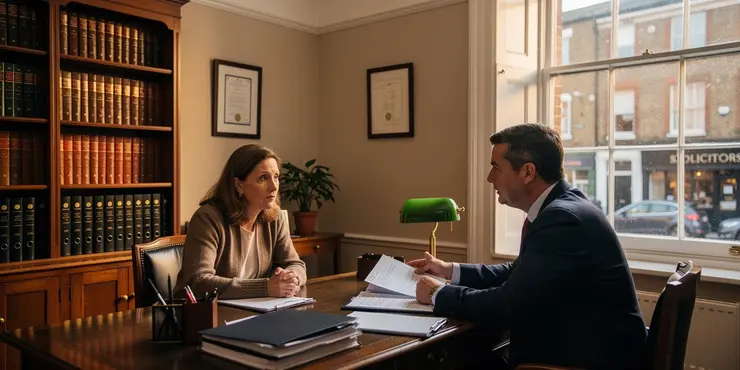

Speak To An Expert
Get clear, personalised advice for your situation.
Jot down a few questions to make the most of your conversation.
Understanding Intestacy in the UK
If you die without a will in the UK, you are said to have died 'intestate.' This means your estate will be distributed according to the rules of intestacy.
The intestacy rules set a strict order for who inherits your estate. This often means your assets may not go to the people you would have chosen.
Who Inherits Under Intestacy Rules?
The rules of intestacy prioritize your closest living relatives. If you are married or in a civil partnership, your spouse or partner is usually first in line.
If you have no spouse or civil partner, your children will inherit your estate. If you have neither, the rules continue to extended family members.
Unmarried partners and close friends are not entitled to inherit under these rules. This can lead to disputes and possible financial hardship for them.
Impact on Minor Children
If you have minor children and die without a will, intestacy can complicate their care arrangements. The law does not automatically assign guardianship.
The courts may be involved in deciding who will look after your children. This process can be lengthy and stressful for all involved.
What If No Relatives Can Be Found?
If no living relatives are identified, your estate passes to the Crown. This is known as 'bona vacantia.'
Your assets may be claimed by the government's Treasury Solicitor. This outcome can be prevented with a valid will outlining your wishes.
Tax Implications
Dying intestate can affect the tax efficiency of your estate. Without a will, your estate may become liable for higher inheritance taxes.
Proper planning through a will can help manage potential tax burdens. This ensures more of your estate is passed to your chosen beneficiaries.
Steps to Take If Concerned
Creating a will is the best way to ensure your wishes are respected. It's advisable to consult with a solicitor to draft a legally sound will.
Review your will regularly to reflect any changes in your circumstances. This simple step can provide peace of mind for you and your loved ones.
Frequently Asked Questions
Intestacy refers to the situation where a person dies without leaving a valid will. In the UK, the distribution of their estate is then governed by the rules of intestacy.
If you die intestate in the UK, your estate is distributed according to the intestacy rules. Typically, this means your spouse or civil partner and children, if you have them, are the first to inherit.
No, unmarried partners do not automatically inherit under intestacy rules. Only spouses and civil partners are entitled to inherit in this situation.
If you die intestate and are survived by a spouse and children, your spouse inherits the first £270,000 of your estate as well as personal possessions, and half of the remaining estate. The other half is split equally among your children.
If you die intestate, an administrator is appointed to manage and distribute your estate. This is often a close family member or the primary beneficiary.
If no relatives can be found, the estate becomes ownerless property, or 'bona vacantia,' and is passed to the Crown.
No, stepchildren do not have automatic rights under intestacy rules unless they have been legally adopted by the deceased.
Yes, inheritance tax may still be applicable on estates over a certain threshold, regardless of whether a will exists.
Jointly owned property usually passes directly to the surviving owner(s) and does not form part of the intestate estate.
Rules may differ for assets outside the UK, depending on local laws of the country where the assets are situated.
If the home is jointly owned, it typically passes to the surviving spouse automatically. If not, they may need to negotiate with other beneficiaries.
Yes, certain dependents or beneficiaries might challenge the distribution through a legal process if they believe they have been unfairly treated.
The statutory legacy amount is currently set at £270,000, which a spouse is entitled to inherit before the remainder of the estate is distributed.
Yes, adopted children have the same rights as biological children under UK intestacy rules.
Without a will, there is no legally binding way to ensure that your funeral wishes are followed, though family members may consider them.
Yes, siblings may inherit if there are no surviving spouse, children, or direct descendants.
The administrator typically needs a Grant of Letters of Administration to manage the estate.
No, a will must be made while the person is alive. Once they die, it cannot be created or altered.
If minor children are involved, their inheritance is usually managed by a legal guardian until they reach adulthood.
The best way to ensure your estate is distributed as you wish is to create a valid will expressing your intentions.

Ergsy Search Results
This website offers general information and is not a substitute for professional advice.
Always seek guidance from qualified professionals.
If you have any medical concerns or need urgent help, contact a healthcare professional or emergency services immediately.
Some of this content was generated with AI assistance. We've done our best to keep it accurate, helpful, and human-friendly.
- Ergsy carefully checks the information in the videos we provide here.
- Videos shown by Youtube after a video has completed, have NOT been reviewed by ERGSY.
- To view, click the arrow in centre of video.
- Most of the videos you find here will have subtitles and/or closed captions available.
- You may need to turn these on, and choose your preferred language.
- Go to the video you'd like to watch.
- If closed captions (CC) are available, settings will be visible on the bottom right of the video player.
- To turn on Captions, click settings.
- To turn off Captions, click settings again.