
Get Answers
Understanding Equipment Standards
Community sports groups in the UK must make sure equipment is safe, suitable, and maintained properly. The exact standard will depend on the activity, but the basic duty is to reduce the risk of injury to participants, volunteers, and spectators.
Equipment should be fit for purpose and used in line with the manufacturer’s instructions. Where relevant, clubs should look for recognised British, European, or international standards that show the item has been tested for safety.
Key Legal and Safety Duties
There is no single rulebook for every sport, but general health and safety law still applies. Group organisers have a duty of care and should carry out sensible checks to make sure equipment does not create avoidable hazards.
The Health and Safety at Work etc. Act 1974 may apply where staff or volunteers are involved, and the Management of Health and Safety at Work Regulations 1999 require risk assessments. For many community groups, this means keeping equipment in a safe condition, recording inspections, and acting quickly if faults are found.
Common Equipment Standards to Look For
For many sports products, conformity with UKCA or CE marking may be relevant, depending on the item and how it is sold. This can apply to equipment such as helmets, protective padding, and some types of fitness or training gear.
Other standards may apply to specific items. For example, football goalposts, climbing gear, gymnastics equipment, and swimming aids may each have specialist standards from organisations such as British Standards or the European Committee for Standardization.
Inspection, Maintenance, and Record Keeping
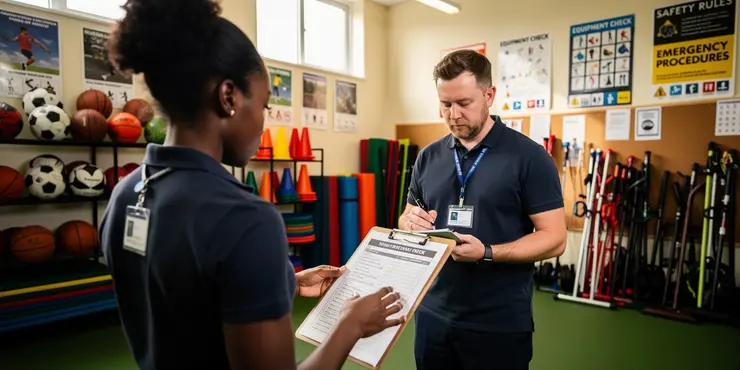
Equipment standards are not just about buying the right product. Clubs should inspect equipment before use, carry out regular maintenance, and replace items that are damaged or worn out.
It is good practice to keep written records of checks, repairs, and replacements. This helps demonstrate that the group is taking reasonable steps to manage risk and can be useful if an incident is investigated.
Children, Disabled Participants, and Higher-Risk Activities
Extra care is needed when equipment is used by children or disabled participants. Items must be age-appropriate, correctly sized, and suitable for the level of ability and supervision provided.
Higher-risk activities such as contact sports, water sports, climbing, or cycling may require more detailed standards and specialist protective equipment. In these cases, the club should follow governing body guidance as well as the manufacturer’s instructions.
Best Practice for Community Groups
Community sports groups should buy from reputable suppliers and check that equipment meets the right standard for the activity. They should also train volunteers on safe use, storage, and reporting defects.
If in doubt, the safest approach is to consult the sport’s national governing body or a qualified safety adviser. Clear checks and good maintenance are often the simplest way to stay compliant and protect everyone involved.
Frequently Asked Questions
Community sports group safety compliance equipment standards are the rules and best practices that define which equipment must be used, how it must be maintained, and how it should be inspected to help keep participants, volunteers, and spectators safe.
Responsibility typically falls on the group’s organizers, coaches, safety officers, and equipment managers, with oversight from the governing organization or facility management if applicable.
These standards commonly cover protective gear, playing surfaces, goalposts or nets, training tools, first aid equipment, inspection tools, and any sport-specific items that could affect participant safety.
Inspection frequency depends on the equipment and sport, but a strong program usually requires checks before use, regular scheduled inspections, and additional inspections after damage, heavy use, or extreme weather.
Documentation often includes inspection logs, maintenance records, purchase and warranty information, incident reports, training records, and proof that equipment meets recognized safety certifications.
Damaged equipment should be removed from use immediately, labeled or isolated so it cannot be accidentally used, and repaired or replaced before being returned to service.
They reduce the risk of injuries caused by faulty, outdated, or unsuitable equipment and help ensure that equipment is appropriate for the participants’ age, skill level, and activity type.
Yes, community sports group safety compliance equipment standards often vary by sport because each activity has unique risks, equipment requirements, and recommended protective gear.
For youth participants, the standards should require age-appropriate sizing, proper fit, increased supervision, and equipment designed to match the participants’ physical development and safety needs.
Manufacturers play a key role by producing equipment that meets recognized safety specifications, providing instructions for safe use, and supplying maintenance or replacement guidance.
Training should cover correct equipment use, inspection procedures, cleaning and storage, reporting defects, emergency response, and the process for removing unsafe equipment from service.
The group should stop using the equipment, assess the risk, repair or replace the item, and document the issue and corrective action before allowing it back into use.
Insurers may require evidence that equipment is inspected, maintained, and replaced according to recognized safety standards, because compliance helps reduce liability and claims risk.
Standards often require equipment to be cleaned after use, dried when needed, stored in secure and appropriate conditions, and protected from damage, moisture, and extreme temperatures.
The group should review policies regularly, track rule or regulation changes, consult governing bodies, update inspection checklists, and retrain staff whenever standards change.
Common consequences include increased injury risk, insurance problems, facility restrictions, legal liability, loss of trust, and possible suspension from leagues or governing organizations.
Emergency equipment such as first aid kits, automated external defibrillators, and communication devices should be included in the standards, maintained regularly, and kept accessible during activities.
Yes, volunteers can help inspect, store, clean, and report equipment issues if they are properly trained and supervised, but final responsibility should remain with designated leaders.
They support inclusive participation by requiring properly sized, accessible, and adaptable equipment so participants of different ages, abilities, and body types can take part safely.
The first step is to identify the sports and activities offered, review applicable laws and governing body rules, and then build a clear equipment policy based on the risks and requirements of those activities.

Ergsy Search Results
This website offers general information and is not a substitute for professional advice.
Always seek guidance from qualified professionals.
If you have any medical concerns or need urgent help, contact a healthcare professional or emergency services immediately.
Some of this content was generated with AI assistance. We've done our best to keep it accurate, helpful, and human-friendly.
- Ergsy carefully checks the information in the videos we provide here.
- Videos shown by Youtube after a video has completed, have NOT been reviewed by ERGSY.
- To view, click the arrow in centre of video.
- Most of the videos you find here will have subtitles and/or closed captions available.
- You may need to turn these on, and choose your preferred language.
- Go to the video you'd like to watch.
- If closed captions (CC) are available, settings will be visible on the bottom right of the video player.
- To turn on Captions, click settings.
- To turn off Captions, click settings again.