
Speak To An Expert
Get clear, personalised advice for your situation.
Jot down a few questions to make the most of your conversation.
Introduction to Scabies
Scabies is a common skin condition caused by tiny mites known as Sarcoptes scabiei. These mites burrow into the skin, leading to intense itching and a rash.
The condition can affect people of all ages and backgrounds. It is highly contagious and spreads easily through close physical contact.
Symptoms of Scabies
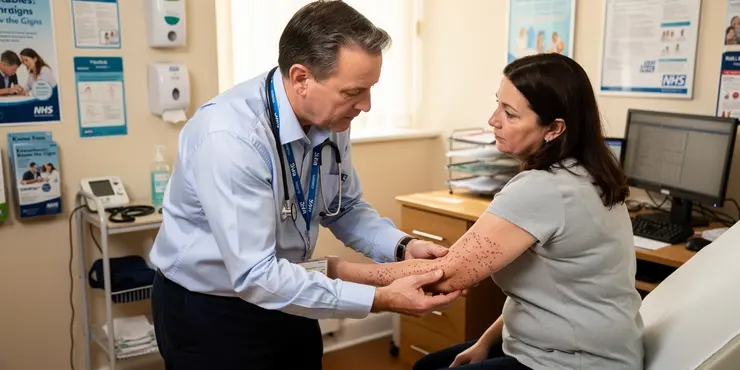
One of the primary symptoms of scabies is intense itching, usually more severe at night. This itching is a result of the body's allergic reaction to the mites.
Another common symptom is the appearance of a rash. This rash typically consists of small red bumps and blisters.
In some cases, the skin may show signs of raised tracks, which are burrows created by the mites. These tracks can appear as thin, wavy lines on the skin.
Causes and Transmission
Scabies is caused by the infestation of the Sarcoptes scabiei mite. These mites are microscopic, making them difficult to see with the naked eye.
The mites spread from person to person through direct skin contact. Transmission can also occur by sharing clothing, bedding, or towels with an infected person.
Close physical contact over a prolonged period is the most common way the mites spread. This makes scabies particularly prevalent in crowded conditions.
Diagnosis and Treatment
To diagnose scabies, a doctor will examine the skin and may take a scraping to look for mites under a microscope. Diagnosis is important to begin treatment promptly.
Treatment usually involves prescribed creams or lotions that are applied to the entire body. These medications kill the mites causing the infestation.
In addition to medical treatment, washing all clothing and bedding in hot water is essential to prevent re-infestation.
Prevention and Management
Preventing scabies involves avoiding direct skin contact with infected individuals. It is also important to refrain from sharing personal items like towels and clothing.
If someone in a household is diagnosed with scabies, it's recommended that all members be treated simultaneously to prevent the spread.
Regular cleaning and disinfection of personal items and living spaces can help manage and reduce the risk of scabies outbreaks.
What is Scabies?
Scabies is a skin problem caused by tiny bugs called mites. These mites dig into your skin, causing very itchy skin and a rash.
Anyone can get scabies, no matter how old they are or where they are from. It spreads easily from one person to another through touch.
Signs of Scabies
The main sign of scabies is very itchy skin, especially at night. This happens because your body reacts to the mites.
You might also see a rash. The rash looks like small red bumps or blisters on your skin.
Sometimes, you can see thin lines on the skin. These lines are where the mites have dug into the skin.
How You Get Scabies
Scabies is caused by tiny mites. These mites are so small you cannot see them without special tools.
The mites can spread from person to person when your skin touches someone else's skin. You can also get them by sharing clothes, bedding, or towels.
Spending a lot of time close to someone with scabies is the most common way to get it. This is why scabies can spread quickly in crowded places.
How to Know and Treat Scabies
To find out if you have scabies, a doctor will look at your skin. They might take a small bit of skin to check for mites with a microscope.
Doctors usually give you special creams or lotions to put on your whole body. These medicines kill the mites.
To stop scabies from coming back, wash all clothes and bedding in hot water.
How to Stop Scabies
You can stop scabies by not touching someone who has it. Do not share personal items like towels and clothes.
If someone in your home has scabies, everyone should get treated at the same time to stop it from spreading.
Keep your home clean and wash things often to help stop scabies from spreading.
Frequently Asked Questions
Scabies is a contagious skin infestation caused by the human itch mite, Sarcoptes scabiei var. hominis.
Scabies is usually spread by direct, prolonged, skin-to-skin contact with a person who has scabies.
The primary symptoms include intense itching and a pimple-like rash. The itching is often more severe at night.
Yes, scabies can affect people of all ages, races, and socio-economic status.
A doctor can diagnose scabies by examining the skin, looking for a typical rash, and possibly taking a skin scraping to examine under a microscope.
Yes, scabies is highly contagious and can spread easily through close physical contact in a family, daycare group, school class, or nursing home.
Scabies is typically treated with prescription scabicidal creams or lotions that are applied to the entire body.
No, over-the-counter treatments are generally not effective for scabies. Prescription medications are needed.
Scabies mites can survive for 24 to 72 hours away from human skin.
Animals do have mites similar to scabies, but these mites usually do not survive or reproduce on humans and typically do not cause severe symptoms.
See a healthcare provider for diagnosis and treatment as soon as possible.
For a first infection, symptoms usually appear in 4 to 8 weeks. In subsequent infections, symptoms can appear within 1 to 4 days.
Yes, scabies can be contracted again if re-exposed to the mites.
Avoid direct skin-to-skin contact with an infected person and do not share clothing, bedding, or towels.
Wash clothing, bedding, and towels in hot water and dry in a hot dryer. Vacuum carpets and clean surfaces.
In some cases, scratching can lead to bacterial infections of the skin, such as impetigo.
No, there is currently no vaccine available for scabies.
Crusted scabies, also known as Norwegian scabies, is a severe form of scabies with thick crusts on the skin, often affecting immunocompromised individuals.
No, scabies mites only infest the skin and do not affect internal organs.
Pets can have their form of mites, but human scabies mites are not suitable for living on pets, and pets typically do not contract scabies from humans.
Scabies is a skin problem that can spread to other people. It is caused by tiny bugs called itch mites that live on your skin.
Scabies spreads when you touch someone's skin for a long time. You can catch it from someone who has scabies.
The main signs are strong itching and a bumpy rash. The itching feels worse at night.
Yes, anyone can get scabies. It doesn't matter how old you are, what your skin color is, or how much money you have.
A doctor can tell if you have scabies by checking your skin. They look for a special kind of rash. Sometimes, they take a tiny piece of your skin to look at under a microscope.
Yes, scabies spreads easily. It can pass from one person to another if they are close. This can happen at home, in a daycare, in a school class, or in a nursing home.
If you want to learn more, you can ask someone you trust to help you. You can also find videos or pictures online that explain scabies more.
Doctors usually treat scabies with special creams or lotions. You put these creams or lotions all over your body. A doctor prescribes them to you.
No, store-bought medicines usually do not work for scabies. You need medicine from a doctor.
Scabies mites can live for 1 to 3 days if they are not on a person’s skin.
Animals have tiny bugs called mites. They are like scabies. These mites do not live long or have babies on people. They usually do not make people very sick.
See a doctor or nurse to find out what is wrong and get help as soon as you can.
When you get sick for the first time, you might feel bad after 4 to 8 weeks. If you get sick again, you might feel unwell much faster, in just 1 to 4 days.
Yes, you can get scabies again if you come into contact with the tiny bugs that cause it.
Stay away from touching someone who is sick. Don't wear their clothes, or use their bedding or towels.
Wash clothes, bedding, and towels in hot water. Use a hot dryer to dry them. Use a vacuum to clean carpets. Wipe and clean surfaces.
Sometimes, scratching your skin can cause it to get infected by bacteria. This can make a problem called impetigo.
No, there is no vaccine for scabies right now.
Crusted scabies is a serious skin problem. It is also called Norwegian scabies. It happens when the skin gets thick crusts. People with weak immune systems get it more often.
Scabies mites live on your skin. They do not go inside your body or hurt your organs.
Pets can get their own kind of mites. But, the mites that cause scabies in people do not live on pets. Usually, pets do not get scabies from people.

Ergsy Search Results
This website offers general information and is not a substitute for professional advice.
Always seek guidance from qualified professionals.
If you have any medical concerns or need urgent help, contact a healthcare professional or emergency services immediately.
Some of this content was generated with AI assistance. We've done our best to keep it accurate, helpful, and human-friendly.
- Ergsy carefully checks the information in the videos we provide here.
- Videos shown by Youtube after a video has completed, have NOT been reviewed by ERGSY.
- To view, click the arrow in centre of video.
- Most of the videos you find here will have subtitles and/or closed captions available.
- You may need to turn these on, and choose your preferred language.
- Go to the video you'd like to watch.
- If closed captions (CC) are available, settings will be visible on the bottom right of the video player.
- To turn on Captions, click settings.
- To turn off Captions, click settings again.