
Get Answers
What is a criminal conviction when volunteering?
A criminal conviction is a formal finding by a court that someone has committed an offence. When people volunteer for community groups in the UK, this may be relevant if the role involves children, vulnerable adults, or positions of trust. Many organisations ask about convictions to help them carry out safeguarding checks and assess risk.
Not every conviction stops someone from volunteering. The impact depends on the type of offence, how long ago it happened, and the nature of the volunteering role. In many cases, organisations take a fair and balanced approach rather than making an automatic decision.
Why community groups ask about convictions
Community groups have a duty to protect the people they support, as well as their staff and other volunteers. Asking about convictions can help them decide whether a person is suitable for a particular role. This is especially important where volunteers may work closely with children, elderly people, or adults at risk.
Some roles may also involve handling money, entering private homes, or using sensitive information. In these situations, a conviction may be relevant to the responsibilities involved. The aim is usually to manage safety, not to exclude people unfairly.
What volunteering can involve
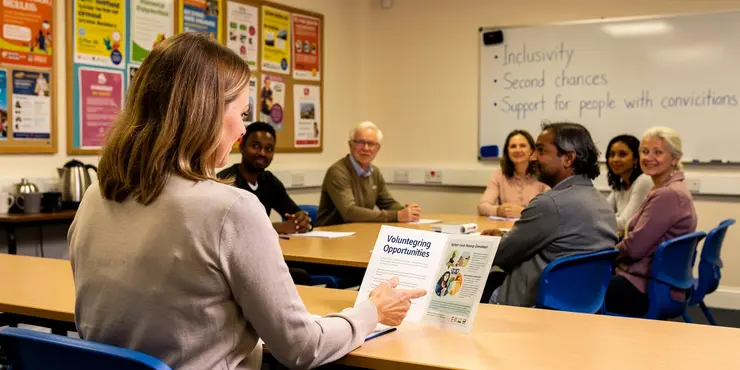
Volunteering for a community group can include helping at a food bank, supporting local events, mentoring young people, or assisting in charity shops. It may also involve driving, fundraising, administration, or befriending isolated people. The level of responsibility varies a lot from one role to another.
Because of this, organisations often ask different questions depending on the role. A low-risk role may need only a simple application form, while a higher-risk role could require references or a DBS check. The process is usually designed to match the level of contact and responsibility involved.
DBS checks and disclosure
Many volunteering roles are subject to a Disclosure and Barring Service check. A basic DBS check shows unspent convictions, while standard and enhanced checks can reveal more information, depending on the role. Some roles may also involve barred list checks if work is regulated.
Applicants should answer questions honestly if asked about convictions. In England and Wales, some convictions become spent under the Rehabilitation of Offenders Act 1974, meaning they do not usually need to be disclosed for many roles. However, exceptions apply in certain safeguarding positions.
How organisations should treat convictions
Good community groups should consider convictions individually and fairly. They should look at the seriousness of the offence, how recently it happened, what has changed since then, and whether it is relevant to the volunteer role. This helps ensure decisions are proportionate.
Many people with convictions volunteer successfully and make a positive contribution to their communities. If someone is unsure what they need to disclose, it may help to ask the organisation directly or seek advice before applying. A clear and open process benefits both volunteers and community groups.
Frequently Asked Questions
Criminal convictions volunteering for community groups involving requirements refers to volunteer roles where an applicant's criminal history is reviewed against specific suitability rules, such as safeguarding, trust, supervision, or access to vulnerable people. The effect depends on the type of conviction, how long ago it occurred, the role involved, and any legal disclosure rules.
Eligibility for criminal convictions volunteering for community groups involving requirements depends on the group's policies, the nature of the volunteering role, and applicable laws. Some convictions may not prevent volunteering, while roles involving children, vulnerable adults, finance, or unsupervised access may have stricter requirements.
Criminal convictions volunteering for community groups involving requirements can trigger safeguarding checks, including references, interviews, and, where permitted, background checks. Organizations use these checks to assess risk and decide whether additional supervision or restrictions are needed.
Yes, many people with criminal convictions can still participate in criminal convictions volunteering for community groups involving requirements. The decision usually depends on the relevance of the conviction to the role, the time since the conviction, evidence of rehabilitation, and the organization's risk assessment.
Convictions involving violence, sexual offences, theft, fraud, drug supply, abuse of trust, or offences against vulnerable people usually matter most for criminal convictions volunteering for community groups involving requirements. The exact relevance depends on the duties, level of access, and whether the role involves safeguarding responsibilities.
Spent convictions may still matter in some criminal convictions volunteering for community groups involving requirements, especially if the role is exempt from normal disclosure rules or if the organization asks about broader suitability. Whether a spent conviction must be disclosed depends on local law and the specific volunteer role.
Unspent convictions are more likely to affect criminal convictions volunteering for community groups involving requirements because they are typically considered current risk information. An organization may assess the conviction, the role, and any safeguards before deciding whether to proceed.
Organizations assess criminal convictions volunteering for community groups involving requirements fairly by considering the nature of the offence, its seriousness, the time elapsed, the applicant's age at the time, patterns of behavior, and evidence of rehabilitation. They should avoid automatic rejection and instead use a role-based risk assessment.
Documents for criminal convictions volunteering for community groups involving requirements often include an application form, identification, references, consent for background checks, and any required disclosures about convictions. Some roles may also require proof of training, safeguarding awareness, or eligibility to volunteer.
The time for criminal convictions volunteering for community groups involving requirements checks varies widely depending on the organization, the type of check, and whether extra review is needed. Basic checks may take days, while more detailed assessments can take several weeks.
Failing to disclose required information for criminal convictions volunteering for community groups involving requirements can result in the application being rejected or the volunteer role being ended. It may also create trust and safeguarding concerns, especially if the nondisclosure relates to a relevant conviction.
Yes, some criminal convictions volunteering for community groups involving requirements can be structured as supervised roles only. Supervision, restricted duties, and no lone-working arrangements may allow an organization to safely include volunteers with certain convictions.
Common restrictions in criminal convictions volunteering for community groups involving requirements include no access to money, no lone contact with children or vulnerable adults, no unsupervised home visits, limited key-holding, and supervision during sensitive tasks. Restrictions are usually tailored to the specific risk identified.
Applicants should explain rehabilitation for criminal convictions volunteering for community groups involving requirements by being honest, concise, and relevant. Helpful details include what changed, how long they have stayed offence-free, any training or support completed, and why the volunteering role is a good fit now.
Yes, criminal convictions volunteering for community groups involving requirements can differ between charities and informal groups because charities often have formal safeguarding policies and screening procedures, while informal groups may have simpler checks. However, both should still assess risk appropriately for the role.
Yes, criminal convictions volunteering for community groups involving requirements involve sensitive personal data, so organizations must handle records carefully, limit access, store information securely, and keep it only as long as needed. Volunteers should be informed about how their information will be used.
Yes, old convictions can still affect criminal convictions volunteering for community groups involving requirements if they are relevant to the role or indicate an ongoing risk. However, older convictions are often weighed less heavily, especially when there is evidence of long-term stability and good conduct.
Community groups considering criminal convictions volunteering for community groups involving requirements should use a consistent policy, assess the role's risks, avoid blanket bans, and document decisions. They should also provide applicants with clear information about disclosure, checks, and appeals.
To appeal a decision about criminal convictions volunteering for community groups involving requirements, the applicant should ask for the reason, provide any missing context, and request a review under the organization's policy. Supporting information such as references, rehabilitation evidence, or clarification of the conviction may help.
Support for criminal convictions volunteering for community groups involving requirements may include advice from probation or rehabilitation services, charity volunteer coordinators, mentoring, references, and role adjustments. These supports can help applicants find appropriate volunteering opportunities and demonstrate readiness for the role.

Ergsy Search Results
This website offers general information and is not a substitute for professional advice.
Always seek guidance from qualified professionals.
If you have any medical concerns or need urgent help, contact a healthcare professional or emergency services immediately.
Some of this content was generated with AI assistance. We've done our best to keep it accurate, helpful, and human-friendly.
- Ergsy carefully checks the information in the videos we provide here.
- Videos shown by Youtube after a video has completed, have NOT been reviewed by ERGSY.
- To view, click the arrow in centre of video.
- Most of the videos you find here will have subtitles and/or closed captions available.
- You may need to turn these on, and choose your preferred language.
- Go to the video you'd like to watch.
- If closed captions (CC) are available, settings will be visible on the bottom right of the video player.
- To turn on Captions, click settings.
- To turn off Captions, click settings again.