
Get Answers
Enhanced Accuracy in Detection
Artificial intelligence (AI) has shown great promise in improving the accuracy of lung cancer detection. Traditional methods can sometimes miss small or subtle nodules, leading to delayed diagnoses.
AI algorithms, trained on vast datasets, can identify patterns and anomalies more precisely. This capability helps in detecting lung cancer at earlier stages, improving patient outcomes.
Efficiency and Speed
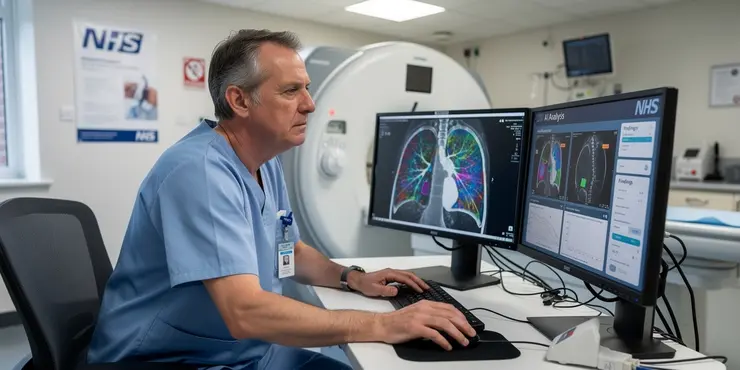
AI systems can process and analyse medical images much faster than human radiologists. This speed is crucial in streamlining the diagnostic process, reducing waiting times for patients.
In busy NHS environments, AI can assist by quickly highlighting areas of concern, allowing radiologists to focus on cases requiring more detailed attention.
Reducing Human Error
Even experienced healthcare professionals are susceptible to fatigue and oversight. AI tools, however, can operate consistently without fatigue, maintaining high levels of performance.
This consistent operation helps reduce the risk of human error, ensuring nothing is overlooked during the analysis of CT scans or X-rays.
Supporting Radiologists
AI does not aim to replace radiologists; rather, it serves as a supportive tool to enhance their capabilities. By providing a second opinion, AI can aid radiologists in making more informed decisions.
This partnership between AI and human expertise can lead to improved diagnostic accuracy, benefiting patient care and treatment planning.
Cost-Effectiveness
The use of AI in lung cancer detection can ultimately lead to cost savings for the healthcare system. Early detection often means less invasive treatments, which are typically less costly than treating advanced cancer stages.
Moreover, by reducing diagnostic errors and unnecessary procedures, AI can help streamline healthcare resources, allowing savings to be redirected to other critical areas.
Continual Learning and Improvement
AI systems continuously improve as they are exposed to more data. This continual learning ensures that AI tools become even more accurate over time, keeping up with the latest medical findings and technological advancements.
This adaptability means patients and healthcare providers can trust that AI tools are using the most current and comprehensive information available.
Frequently Asked Questions
AI can enhance the accuracy and efficiency of lung cancer detection by analyzing complex patterns in medical images that may be challenging for human radiologists to identify.
AI can process medical images much faster than human clinicians, leading to quicker detection and diagnosis, which is critical for timely treatment.
Yes, AI algorithms can be trained to better distinguish between benign and malignant nodules, potentially reducing the number of false positives.
AI has the capability to detect subtle patterns and anomalies in imaging data, which can help reduce the occurrence of false negatives, ensuring that fewer cases are missed.
AI can be cost-effective by streamlining the diagnostic process, reducing the need for unnecessary follow-up procedures, and optimizing resource allocation in healthcare settings.
Yes, AI can act as a supportive tool for radiologists, providing a second opinion and helping them to make more informed decisions based on data-driven insights.
AI systems can efficiently analyze and process large volumes of imaging data, which supports the scalability of lung cancer screening programs.
AI can improve the early detection of lung cancer by identifying minimal but significant changes in lung tissue, which are often indicators of early-stage cancer.
AI is trained using large datasets of annotated medical images, where it learns to recognize patterns and features associated with lung cancer.
AI can analyze a patient's imaging data alongside other health information, providing insights that contribute to more personalized and effective treatment plans.
AI can be used to track changes over time in a patient's lung images, helping to monitor cancer progression or response to treatment.
AI has the potential to improve patient outcomes by enabling earlier and more accurate detection, which can lead to more effective interventions.
AI provides consistent and standardized analysis, reducing variability in diagnosis that can occur between different human radiologists.
AI algorithms can be trained to recognize specific characteristics of different lung nodules, aiding in distinguishing between various types and determining their malignancy.
AI has the potential to detect subtle early-stage signs of lung cancer that may be overlooked by human observers, facilitating earlier intervention.
By automating parts of the detection process, AI can reduce the workload on radiologists and other healthcare professionals, allowing them to focus on patient care.
AI's ability to analyze vast data sets with precision helps reduce diagnostic errors, ensuring a higher accuracy in lung cancer detection.
AI can be particularly beneficial in resource-limited settings by allowing for effective screening processes in areas with limited access to specialized medical professionals.
Advancements in AI contribute to the development of more sophisticated algorithms, improving the capabilities and accuracy of lung cancer detection technologies.
AI can analyze complex datasets to uncover new patterns and insights, contributing to lung cancer research and the development of new diagnostic and treatment strategies.

Ergsy Search Results
This website offers general information and is not a substitute for professional advice.
Always seek guidance from qualified professionals.
If you have any medical concerns or need urgent help, contact a healthcare professional or emergency services immediately.
Some of this content was generated with AI assistance. We've done our best to keep it accurate, helpful, and human-friendly.
- Ergsy carefully checks the information in the videos we provide here.
- Videos shown by Youtube after a video has completed, have NOT been reviewed by ERGSY.
- To view, click the arrow in centre of video.
- Most of the videos you find here will have subtitles and/or closed captions available.
- You may need to turn these on, and choose your preferred language.
- Go to the video you'd like to watch.
- If closed captions (CC) are available, settings will be visible on the bottom right of the video player.
- To turn on Captions, click settings.
- To turn off Captions, click settings again.