
Get Answers
What is MND?
Motor neurone disease (MND) is a progressive neurological condition that affects the nerves that control movement. These nerves, called motor neurones, stop working properly and gradually weaken muscles over time.
There is no single test that can confirm MND straight away. Diagnosis usually involves a careful assessment, because the early symptoms can look like other conditions.
When to see a GP
You should see a GP if you notice muscle weakness, slurred speech, cramps, twitching, or problems with walking, swallowing, or grip. These symptoms do not always mean MND, but they should be checked promptly.
Early diagnosis can help you get the right support and rule out other possible causes. Your GP will usually ask about your symptoms, how long they have been happening, and whether they are getting worse.
How MND is investigated
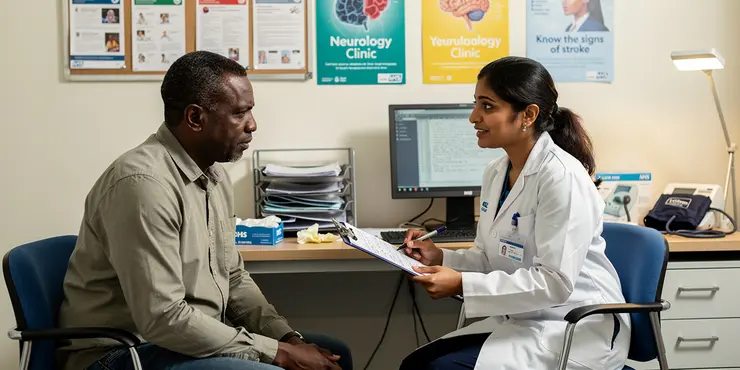
If MND is suspected, your GP will refer you to a neurologist, usually through the NHS. A neurologist is a specialist in conditions affecting the brain, nerves, and muscles.
The specialist will take a full medical history and carry out a neurological examination. They may test your strength, reflexes, coordination, balance, speech, and swallowing.
Tests used to rule out other conditions
MND is often diagnosed by excluding other illnesses that can cause similar symptoms. Blood tests may be used to check for vitamin deficiencies, thyroid problems, infections, or inflammation.
You may also have nerve and muscle tests, such as EMG and nerve conduction studies. These tests measure how well your nerves and muscles are working and can help distinguish MND from other disorders.
Scans such as an MRI may be arranged to look for problems in the brain or spinal cord. In some cases, additional tests like a lumbar puncture or breathing checks may be needed.
Getting a diagnosis
Diagnosis is based on the pattern of symptoms, examination findings, and test results. Doctors look for signs that both upper and lower motor neurones are affected, while making sure there is no better explanation.
Because MND can be difficult to diagnose early, it may take time before a clear answer is reached. Some people are diagnosed after several appointments and tests over weeks or months.
What happens after diagnosis
If MND is diagnosed, you should be referred to a multidisciplinary team for ongoing care and support. This may include a neurologist, specialist nurse, physiotherapist, speech and language therapist, and occupational therapist.
You can also ask for information about treatment, symptom management, and support services. In the UK, organisations such as the MND Association can provide guidance for patients and families.
Frequently Asked Questions
MND diagnosis is the medical process of identifying motor neurone disease based on symptoms, neurological examination, and tests that help rule out other conditions. There is no single definitive test, so specialists usually combine clinical findings, blood tests, scans, nerve tests, and follow-up over time.
Early signs that may lead to MND diagnosis can include muscle weakness, twitching, cramps, stiffness, clumsiness, slurred speech, or trouble swallowing. Symptoms depend on which motor neurones are affected first, and they often worsen gradually over time.
For MND diagnosis, you should usually see a neurologist, ideally one with experience in motor neurone disease. A general practitioner often makes the first referral, and specialist assessment is usually needed to confirm the diagnosis and exclude other causes.
The time for MND diagnosis varies widely and may take weeks to months, sometimes longer. This is because symptoms can resemble other disorders, and doctors often need several tests and repeat assessments before reaching a confident diagnosis.
Tests used in MND diagnosis often include neurological examination, electromyography, nerve conduction studies, MRI scans, blood tests, and sometimes lumbar puncture or genetic testing. These tests help support the diagnosis and exclude other conditions that can mimic MND.
No, there is usually no single test that confirms MND diagnosis. Diagnosis is mainly clinical, supported by tests that show signs of motor neurone damage and help rule out alternative explanations for the symptoms.
MND diagnosis can be difficult because early symptoms may be subtle and overlap with many other neurological, muscle, or spine-related conditions. Doctors often need time, specialist evaluation, and repeat testing to see whether the pattern fits motor neurone disease.
During MND diagnosis, doctors commonly rule out conditions such as cervical spine problems, peripheral neuropathy, myasthenia gravis, multiple sclerosis, muscle disorders, vitamin deficiencies, thyroid disease, and some infections or inflammatory disorders.
Blood tests can help with MND diagnosis, but mainly by excluding other illnesses rather than confirming MND. They may check for vitamin deficiencies, thyroid problems, inflammation, infection, autoimmune disease, or muscle damage.
MRI scans can help with MND diagnosis by looking for structural or inflammatory causes of symptoms, such as spinal cord compression, stroke, or other brain and nerve conditions. MRI usually does not confirm MND itself, but it is useful in excluding other diagnoses.
Electromyography, or EMG, is often an important part of MND diagnosis because it can detect abnormal electrical activity in muscles that suggests motor neurone damage. It helps specialists support the diagnosis and distinguish MND from other neuromuscular conditions.
Family history can affect MND diagnosis because some cases are inherited. If relatives have had motor neurone disease or related conditions, doctors may consider genetic forms of MND and may recommend genetic counseling or testing in certain situations.
Age can affect MND diagnosis because MND is more common in older adults, although it can occur at younger ages too. Doctors interpret symptoms, test results, and alternative diagnoses in the context of the person's age and overall health.
Yes, speech or swallowing problems can lead to MND diagnosis, especially when they occur with tongue weakness, muscle wasting, or limb weakness. These symptoms may indicate bulbar involvement and usually prompt urgent neurological evaluation.
MND diagnosis can sometimes be suspected when symptoms are first limited to one body area, such as one arm, one leg, or the speech and swallowing muscles. However, doctors often need time and repeat examinations to see whether the disease pattern is consistent with MND.
At the first appointment for MND diagnosis, you should expect a detailed history of your symptoms, a neurological examination, and discussion of possible tests. The specialist may also ask about family history, symptom progression, and any signs that suggest other conditions.
Yes, MND diagnosis can sometimes be mistaken for other conditions, especially early on. Conditions affecting nerves, muscles, the spine, or the brain can produce similar weakness or speech symptoms, which is why specialist assessment is important.
MND diagnosis is usually explained by discussing which symptoms and test results support the diagnosis, what other conditions were considered, and what the likely next steps are. Doctors may also talk about prognosis, symptom management, and support services.
Yes, genetic testing can be part of MND diagnosis in selected cases, especially when there is a family history or younger onset. It may help identify inherited forms of MND and can be useful for family counseling and future planning.
After receiving an MND diagnosis, you should usually be referred to a specialist multidisciplinary team for support with symptoms, mobility, communication, nutrition, and planning. Early involvement of healthcare professionals can improve symptom control and help you access services and support.

Ergsy Search Results
This website offers general information and is not a substitute for professional advice.
Always seek guidance from qualified professionals.
If you have any medical concerns or need urgent help, contact a healthcare professional or emergency services immediately.
Some of this content was generated with AI assistance. We've done our best to keep it accurate, helpful, and human-friendly.
- Ergsy carefully checks the information in the videos we provide here.
- Videos shown by Youtube after a video has completed, have NOT been reviewed by ERGSY.
- To view, click the arrow in centre of video.
- Most of the videos you find here will have subtitles and/or closed captions available.
- You may need to turn these on, and choose your preferred language.
- Go to the video you'd like to watch.
- If closed captions (CC) are available, settings will be visible on the bottom right of the video player.
- To turn on Captions, click settings.
- To turn off Captions, click settings again.