
Get Answers
What is MND?
Motor neurone disease, often called MND, is a group of conditions that affect the nerves that control movement. These nerves, known as motor neurones, gradually stop working properly.
As the condition develops, muscles become weaker and may waste away. Symptoms can vary from person to person, which is why diagnosis can sometimes take time.
When to see a GP
You should see your GP if you notice persistent muscle weakness, tripping, slurred speech, swallowing problems, or twitching. These symptoms do not always mean MND, but they do need checking.
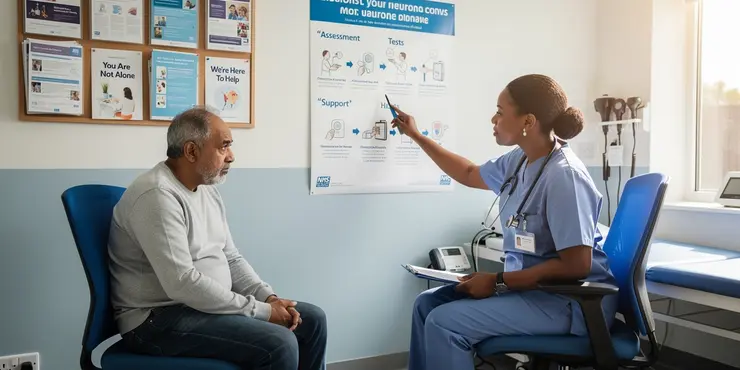
Your GP will ask about your symptoms, how long they have been happening, and whether they are getting worse. They may also check your reflexes, strength, coordination, and speech.
Initial assessment and referrals
If your GP suspects a neurological problem, they will usually refer you to a neurologist. In the UK, this is typically done through NHS specialist services.
The neurologist will look for signs that point to MND and rule out other conditions that can cause similar symptoms. Because there is no single test for MND, diagnosis is based on a combination of findings.
Tests used to diagnose MND
Several tests may be carried out to help confirm the diagnosis and exclude other causes. These can include blood tests, scans, and nerve tests such as electromyography, or EMG.
EMG measures the electrical activity in muscles and can show whether nerves are not working normally. Nerve conduction studies may also be used to check how well signals travel along the nerves.
Doctors may arrange an MRI scan of the brain and spine. This helps rule out conditions such as a slipped disc, stroke, or inflammation that could be causing the symptoms.
How the diagnosis is made
MND is diagnosed by looking at the pattern of symptoms, examination results, and test findings over time. A specialist will assess whether weakness is spreading and whether there are signs of upper and lower motor neurone damage.
It is important to know that MND cannot usually be confirmed with one test alone. In some cases, repeated appointments are needed before a clear diagnosis can be made.
After diagnosis
If MND is diagnosed, you should be referred to a multidisciplinary team as soon as possible. This team may include neurologists, nurses, physiotherapists, speech and language therapists, dietitians, and occupational therapists.
Getting an early diagnosis can help you access treatment, support, and planning for the future. If you are worried about symptoms, speak to your GP as soon as you can.
Frequently Asked Questions
MND diagnosis is the clinical process of confirming motor neurone disease based on symptoms, neurological examination, test results, and ruling out other conditions. There is no single definitive test for MND, so diagnosis is usually made by a specialist using a combination of assessments.
Early signs that may lead to MND diagnosis can include muscle weakness, cramps, twitching, slurred speech, difficulty swallowing, tripping, hand weakness, or unexplained fatigue. These symptoms can also occur in other conditions, so specialist evaluation is important.
An MND diagnosis is usually made by a neurologist, often one with experience in motor neurone disease or neuromuscular disorders. The diagnosis may involve input from other specialists such as speech therapists, physiotherapists, and respiratory clinicians.
Tests commonly used in MND diagnosis may include neurological examination, nerve conduction studies, electromyography, blood tests, MRI scans, and sometimes lumbar puncture or genetic testing. These tests help support the diagnosis and exclude other causes.
MND diagnosis can take weeks or months because symptoms may overlap with other diseases and several tests are often needed. The timeline varies depending on symptom pattern, test availability, and how quickly the condition progresses.
MND diagnosis can be difficult because early symptoms are often subtle, variable, and similar to other neurological or muscle disorders. Doctors must rule out many possible causes before confirming MND.
No, MND diagnosis cannot usually be made from an MRI scan alone. MRI is mainly used to rule out other conditions that can mimic MND, such as structural problems in the brain or spinal cord.
Blood tests cannot confirm MND diagnosis on their own. They are used to look for alternative causes of weakness, such as vitamin deficiencies, thyroid disease, inflammation, infection, or muscle disorders.
Yes, nerve conduction studies can help with MND diagnosis by assessing how well nerves transmit signals. They are often combined with electromyography to detect patterns of nerve and muscle involvement consistent with MND.
Electromyography in MND diagnosis is a test that measures the electrical activity of muscles. It helps detect signs of denervation and muscle changes that can support a diagnosis of motor neurone disease.
MND diagnosis and ALS diagnosis are often related because ALS is the most common form of motor neurone disease in many countries. The terms are sometimes used differently depending on the region, but both refer to disorders affecting motor neurons.
During MND diagnosis, doctors may rule out conditions such as multiple sclerosis, cervical spondylosis, peripheral neuropathy, myasthenia gravis, muscle disease, vitamin deficiencies, thyroid disorders, and some infections or inflammatory diseases.
Yes, genetic testing can be part of MND diagnosis in some cases, especially if there is a family history or if symptoms suggest a hereditary form. Genetic testing does not diagnose all MND cases, but it can identify known inherited mutations.
Symptoms that often prompt referral for MND diagnosis include progressive weakness, muscle wasting, fasciculations, speech changes, swallowing problems, foot drop, and hand clumsiness. A general practitioner may refer urgently if these symptoms are progressive.
Yes, symptom progression is an important part of MND diagnosis. Doctors look for a pattern of worsening weakness or muscle dysfunction affecting different body regions over time, along with supportive examination and test findings.
MND diagnosis can sometimes be made at an early stage, but it is not always straightforward because early symptoms may be mild or non-specific. Specialist follow-up may be needed if the diagnosis is uncertain.
At the first appointment for MND diagnosis, you can expect a detailed medical history, neurological examination, discussion of symptoms, and plans for further tests. The specialist may also ask about family history, swallowing, breathing, and daily function.
No, a normal test result does not always rule out MND diagnosis because some tests may be normal early in the disease. Doctors interpret all findings together, including symptoms, examination, and progression over time.
Bulbar-onset MND diagnosis is based on symptoms that begin with speech or swallowing problems, while limb-onset MND diagnosis begins with weakness in an arm or leg. Both forms are diagnosed using the same overall clinical and test-based approach.
After MND diagnosis is confirmed, the specialist usually discusses the diagnosis, explains likely progression, and arranges multidisciplinary care. This may include support for mobility, communication, nutrition, breathing, symptom control, and emotional support.

Ergsy Search Results
This website offers general information and is not a substitute for professional advice.
Always seek guidance from qualified professionals.
If you have any medical concerns or need urgent help, contact a healthcare professional or emergency services immediately.
Some of this content was generated with AI assistance. We've done our best to keep it accurate, helpful, and human-friendly.
- Ergsy carefully checks the information in the videos we provide here.
- Videos shown by Youtube after a video has completed, have NOT been reviewed by ERGSY.
- To view, click the arrow in centre of video.
- Most of the videos you find here will have subtitles and/or closed captions available.
- You may need to turn these on, and choose your preferred language.
- Go to the video you'd like to watch.
- If closed captions (CC) are available, settings will be visible on the bottom right of the video player.
- To turn on Captions, click settings.
- To turn off Captions, click settings again.