
Get Answers
How Solar Panels Affect Property Value
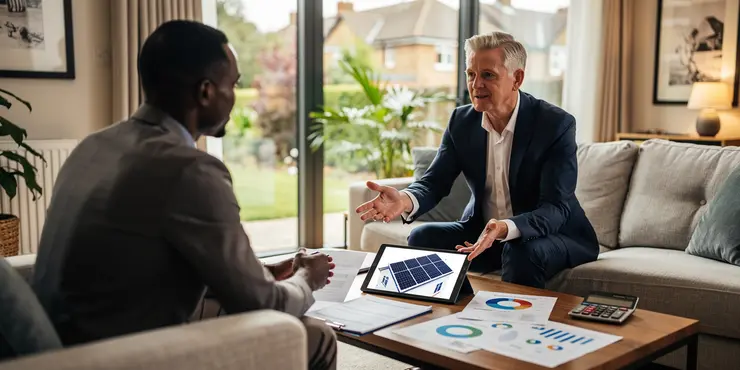
Solar panels can increase a home’s appeal because they often lower electricity bills and improve energy efficiency. For many UK buyers, that means a property feels cheaper to run from day one.
The value uplift is not always the same for every home. It depends on factors such as system size, installation quality, roof condition, and whether the panels are owned outright or leased.
How Long the Value Increase Can Last
The increase in property value can last for as long as the solar panels remain a practical benefit to the home. In many cases, that means the uplift continues throughout the life of the system, which is often 25 years or more.
However, the strongest value boost is usually seen while the panels are relatively new and still delivering reliable savings. As the system ages, buyers may start to focus more on maintenance history and remaining lifespan.
What UK Buyers Look For
UK buyers often like homes with lower running costs, especially as energy prices rise. Solar panels can help a property stand out in a competitive market, particularly if the house has a good Energy Performance Certificate rating.
Buyers also tend to value ownership certainty. A fully owned system is generally more attractive than one tied to a lease or roof rent agreement, because it avoids extra legal and financial complications.
When the Benefit May Be Smaller
The uplift may be smaller if the panels are old, poorly maintained, or installed on a roof that soon needs replacement. In those cases, a buyer may see the system as a future expense rather than a clear advantage.
Shading, low output, or outdated inverters can also reduce the appeal. If the panels no longer generate meaningful savings, the property value benefit may diminish sooner.
Practical Timescale for Homeowners
In simple terms, solar panels can add value immediately after installation and continue to do so for decades if the system performs well. The effect is not fixed to a short period, because buyers usually value the future savings as well as the current ones.
For the best results, keep records of installation, warranties, and annual performance. A well-documented system helps reassure buyers that the panels will remain a useful asset for many years.
Frequently Asked Questions
It means adding solar panels may make a home more attractive to buyers and potentially raise its market value after the system is installed.
They can improve resale value by lowering future electricity costs and appealing to buyers who want energy savings and sustainability.
Buyers often value lower utility bills, modern upgrades, and environmental benefits, which can make a solar-equipped home more desirable.
System size, local electricity rates, panel ownership, roof condition, home location, and buyer demand all influence the value increase.
Owned systems usually add more value because the buyer receives the equipment and the long-term energy benefits without ongoing lease payments.
The amount varies by market, but studies often show a modest to significant premium depending on energy savings and local demand.
No, the impact depends on the local real estate market, electricity costs, buyer preferences, and how common solar is in the area.
An older roof can reduce the value boost because buyers may see additional replacement costs, even if the solar system itself is valuable.
Yes, incentives can help reduce installation costs, and the resulting energy savings and system ownership can still support higher property value.
Appraisers consider ownership status, system condition, energy savings, comparable sales, and any added market appeal from the solar installation.
Yes, higher electricity prices often make solar more valuable because the monthly savings are larger and more attractive to buyers.
Yes, existing homes can gain value from solar if the system is well maintained and clearly reduces operating costs.
Poor maintenance, damaged equipment, outdated inverters, or reduced performance can weaken the value benefit of a solar installation.
Sunny regions may see stronger interest, but value also depends on electricity rates, policy incentives, and how buyers view energy savings.
They can keep purchase records, warranties, utility bill savings, installation details, and performance data to show the system's benefits.
Yes, paid-off solar systems often appeal more to buyers because they provide energy savings without monthly financing or lease obligations.
Battery storage can increase appeal by improving backup power and self-consumption, which may add more value in some markets.
Rules about net metering, property taxes, permitting, and disclosure can affect buyer demand and the overall value impact.
Yes, but the premium may be smaller if buyers do not have time to fully understand the energy savings and system benefits.
Sellers should highlight ownership status, estimated monthly savings, equipment age, warranties, and any transferable benefits that support the home's value.

Ergsy Search Results
This website offers general information and is not a substitute for professional advice.
Always seek guidance from qualified professionals.
If you have any medical concerns or need urgent help, contact a healthcare professional or emergency services immediately.
Some of this content was generated with AI assistance. We've done our best to keep it accurate, helpful, and human-friendly.
- Ergsy carefully checks the information in the videos we provide here.
- Videos shown by Youtube after a video has completed, have NOT been reviewed by ERGSY.
- To view, click the arrow in centre of video.
- Most of the videos you find here will have subtitles and/or closed captions available.
- You may need to turn these on, and choose your preferred language.
- Go to the video you'd like to watch.
- If closed captions (CC) are available, settings will be visible on the bottom right of the video player.
- To turn on Captions, click settings.
- To turn off Captions, click settings again.