
Get Answers
Introduction to Vision Testing
Vision charts, commonly known as eye charts, are essential tools used to measure visual acuity. They help identify whether a person might need corrective lenses or further examination by an eye care professional. While professional testing is ideal, you can perform a simple self-test at home using a vision chart as a preliminary measure.
Understanding the Vision Chart
The most familiar type of vision chart is the Snellen chart, which displays letters of decreasing size on successive lines. Each line corresponds to a fraction that represents your visual acuity compared to standard vision. In the UK, vision is often described as '6/6', which means you can see clearly at 6 metres what is normally seen at that distance.
Setting Up Your Test Area
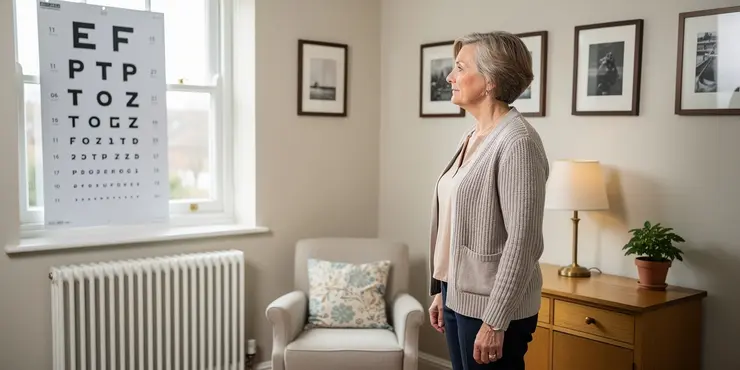
To begin a self-test, you'll need to print a suitable vision chart from a reliable online source. Ensure the chart is printed to scale, usually indicated on the download page. Secure the chart on a wall at eye level in a well-lit area where you can stand or sit at least 3 metres away. Measure the distance accurately to maintain the test's validity.
Conducting the Self-Test
Stand or sit at the predetermined distance and cover one eye with a hand or patch without applying pressure, as this can affect the result. Read aloud the smallest line of letters you can see clearly. Note which line that is. Then, cover the opposite eye and repeat the process. Both eyes should have similar results if your vision is normal.
Interpreting the Results
Each line on the chart corresponds to a standard vision level. For instance, being able to read down to the line marked 6/12 means you can see at 6 meters what a person with typical vision can see at 12 meters. If you find yourself struggling to read lines that indicate 6/6 vision or noticing significant differences between eyes, it may be time to consult an optometrist.
Limitations and Advice
Keep in mind that a self-test is not a substitute for a professional eye examination. Factors like lighting, print quality, and eye condition can affect results. Regular eye check-ups are recommended, even if self-tests show normal vision. If you experience headaches, eye strain, or find reading difficult even with normal self-test results, seek professional advice.
Conclusion
Self-testing using a vision chart is a convenient way to assess if there's a potential issue with your sight. However, it is vital to supplement this with regular professional examinations to ensure comprehensive eye care and health. Should any issues arise during your self-test, do not hesitate to book an appointment with a qualified optician in the UK.
Introduction to Vision Testing
Vision charts, also known as eye charts, help us see how well we can see. They show if someone might need glasses or need to see an eye doctor. While it's best to see a professional, you can use a vision chart at home to do a simple check on your eyes.
Understanding the Vision Chart
The Snellen chart is a popular type of vision chart. It has lines of letters that get smaller on each line. Each line tells you about how well you can see. In the UK, people say your vision is '6/6' if you can see clearly at 6 metres what most people can see at that distance.
Setting Up Your Test Area
To check your eyesight at home, you need to print a vision chart from a trustworthy website. Make sure the chart is the right size. Put the chart on a wall at the same height as your eyes. The room should be bright, and you should be able to stand or sit at least 3 metres away from the chart. Measure this distance to make sure it’s correct.
Conducting the Self-Test
Stand or sit at the right distance. Cover one eye with your hand, but don't press on it. Read aloud the smallest line of letters you can see. Remember which line you read. Then, cover the other eye and do the same. Both eyes should see about the same if your eyes are healthy.
Interpreting the Results
Each line on the chart shows a level of seeing. If you can read the line marked 6/12, it means you see at 6 metres what people with normal vision see at 12 metres. If you can't read the lines marked 6/6 or if your eyes see differently, it might be time to see an eye doctor.
Limitations and Advice
A self-test is not as good as a professional eye check. Things like lighting, chart print, and eye health can change the results. Even if your test is normal, getting your eyes checked by a professional is a good idea. If you have headaches, eye strain, or trouble reading, get advice from an eye doctor.
Conclusion
Testing your eyes at home with a vision chart can help you know if there’s a problem. But regular visits to an eye doctor are important to keep your eyes healthy. If your home test shows problems, make an appointment with an eye doctor in the UK.
Frequently Asked Questions
A vision chart is an eye chart used to measure visual acuity. The most common type is the Snellen chart, which has letters of decreasing size.
Yes, you can use a vision chart at home for a basic self-test of your visual acuity, but it is not a replacement for a professional eye exam.
You can find free printable vision charts online or purchase them from various retailers.
Hang the chart on a wall at eye level, ensure adequate lighting, and stand the correct distance away, usually 20 feet for a Snellen chart.
For a standard Snellen chart, you should stand 20 feet away from the chart.
You can use a mirror to double the distance or find a smaller-scale chart designed for shorter distances.
Read the letters on the chart from top to bottom. Your visual acuity is determined by the smallest line you can read accurately.
Normal vision is 20/20, meaning you can read at 20 feet what a person with normal vision can read at that distance.
The first number is the testing distance, and the second is the distance at which a person with normal vision can read the line.
Self-testing can give you a rough idea of your visual acuity but is not as accurate as a test conducted by an optometrist.
No, it primarily measures visual acuity and may not detect issues like glaucoma, cataracts, or color blindness.
First test with your corrective lenses to check their effectiveness, then without to gauge your natural vision.
If no changes are noticed, testing every six months is fine, but consult an eye doctor if you notice any vision changes.
If you cannot read the 20/20 line, consider scheduling an eye exam with an optometrist for a comprehensive evaluation.
Yes, but it's best to have adult supervision to ensure the test is conducted properly and to interpret the results.
Improper lighting, incorrect distance, and an outdated or blurry chart can all affect accuracy.
Yes, several apps and websites offer digital eye tests, but they should not replace professional evaluations.
A chart with larger print, or a specialized chart for low vision, may be more appropriate.
Standard vision charts do not test for astigmatism, but some specialized charts and tests do exist for this purpose.
No prescription is required; vision charts can be purchased or printed online freely.
A vision chart helps check how well you see. It is an eye chart. The most common one is called the Snellen chart. This chart shows letters that get smaller and smaller.
Yes, you can use an eye chart at home to check your eyesight. But, it does not replace seeing an eye doctor for a professional check-up.
You can look on the internet to find free vision charts that you can print. You can also buy them from different shops.
Put the chart on a wall where you can see it straight in front of your eyes. Make sure the room is bright enough to see well. Stand back from it, about as far as a school bus is long. Most charts need you to be 20 feet away to read them correctly.
Stand 20 steps away from the eye chart.
You can use a mirror to make things look farther or find a smaller chart for shorter distances.
Look at the chart with letters. Read the letters starting at the top and going down to the bottom. Your eyesight is measured by the smallest row of letters you can read correctly.
Having normal vision means you have 20/20 eyesight. This means when you look at something 20 feet away, you can see it clearly, just like most people with normal eyesight.
The first number tells how far away you stand to take the eye test. The second number shows how far someone with normal eyesight can read that line.
Here are some ways to help understand:
- Read slowly and take your time.
- Use a pointer or your finger to follow the words.
- Ask someone to read with you. They can help explain if needed.
Testing your own eyes can help you understand a little bit about how well you see. But seeing an eye doctor is much better for knowing how well your eyes work.
No, it mostly checks how well you can see things clearly. It won't tell you if you have problems like glaucoma, cataracts, or trouble seeing colors.
First, put on your glasses or contact lenses to see how well they help you see. Next, take them off to check how your eyes see on their own.
If nothing changes with your eyesight, it's okay to have an eye test every six months. But if you see anything different, talk to an eye doctor.
If you have trouble seeing the 20/20 line, you should see an eye doctor. They can check your eyes carefully to help you see better.
Yes, but it's good to have an adult help. They can make sure the test is done right and help understand what it means.
Bad lighting, being too close or too far, and using an old or blurry chart can make things wrong.
Yes, there are some apps and websites that can check your eyes. But, it's important to still see an eye doctor for a check-up.
A chart with bigger letters might be better. There are special charts for people who can't see well.
Regular eye charts don't check for astigmatism. But, there are special charts and tests that can help find it.
You don't need a doctor’s note; you can buy or print eye test charts online for free.

Ergsy Search Results
This website offers general information and is not a substitute for professional advice.
Always seek guidance from qualified professionals.
If you have any medical concerns or need urgent help, contact a healthcare professional or emergency services immediately.
Some of this content was generated with AI assistance. We've done our best to keep it accurate, helpful, and human-friendly.
- Ergsy carefully checks the information in the videos we provide here.
- Videos shown by Youtube after a video has completed, have NOT been reviewed by ERGSY.
- To view, click the arrow in centre of video.
- Most of the videos you find here will have subtitles and/or closed captions available.
- You may need to turn these on, and choose your preferred language.
- Go to the video you'd like to watch.
- If closed captions (CC) are available, settings will be visible on the bottom right of the video player.
- To turn on Captions, click settings.
- To turn off Captions, click settings again.