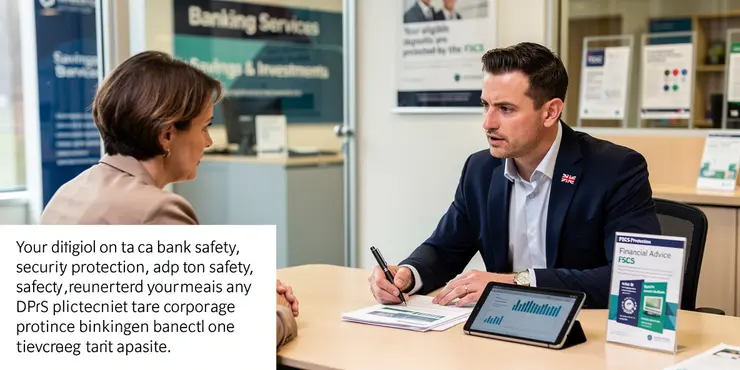

Speak To An Expert
Get clear, personalised advice for your situation.
Jot down a few questions to make the most of your conversation.
Check for FSCS Protection
One of the key indicators of a secure bank in the UK is its participation in the Financial Services Compensation Scheme (FSCS). This scheme protects your money up to £85,000 per person, per bank.
Check the bank's website or contact them directly to confirm their FSCS membership. This information is usually prominently displayed, as it's a significant factor in consumer trust.
Look for Strong Financial Ratings
Financial ratings provide insights into a bank's stability and security. These ratings are given by agencies such as Moody’s, Fitch, and Standard & Poor’s.
Access these ratings online, either through the bank's investor relations page or the rating agency's websites. Higher ratings indicate greater financial health and lower risk.
Review Data Security Measures
With increasing digital threats, a secure bank should have robust data protection measures. Look for banks that utilize encryption and multi-factor authentication.
Banks should clearly outline their security protocols on their websites. Don’t hesitate to reach out to the bank if you have any concerns about data security.
Assess Online Banking Features
Secure banks offer reliable online banking features with strong authentication processes. Look for websites with secure URLs that start with "https."
A user-friendly mobile app with security features like biometric login is another positive sign. These features enhance convenience while ensuring security.
Consider Customer Reviews and Reputation
Customer reviews offer real-world insights into a bank’s reliability and customer service. Browse trusted review sites like Trustpilot for honest feedback.
A bank with a long-standing reputation for good service typically reflects quality and transparency. However, be cautious and consider multiple reviews before forming an opinion.
Verify with Regulators
The Prudential Regulation Authority (PRA) and the Financial Conduct Authority (FCA) regulate banks in the UK. Verify that the bank is authorized by these bodies.
You can search the FCA's online register to confirm a bank's status. This provides an extra layer of assurance that the bank operates under strict regulations.
Frequently Asked Questions
You can verify if a bank is insured by checking with the Federal Deposit Insurance Corporation (FDIC) in the United States. They provide an online tool called BankFind to check if a bank is FDIC-insured.
A secure bank has robust security measures in place to protect its customer's data and financial assets, such as encryption, fraud detection, and strong authentication procedures.
No, FDIC insurance is specific to the United States. Other countries have their own deposit insurance systems.
Look for HTTPS in the bank's web address, two-factor authentication, strong password policies, and regularly updated security practices.
FDIC insurance covers up to $250,000 per depositor, per insured bank, for each account ownership category.
While a bank might have strong security measures, it's the FDIC insurance that guarantees your deposits are protected up to a limit if the bank fails.
In Europe, many countries have their own deposit guarantee schemes. For example, the UK has the Financial Services Compensation Scheme (FSCS).
Red flags include lack of transparency, no clear information on deposit insurance, poor online security measures, and negative reviews regarding security issues.
Online banks are generally protected if they are FDIC-insured or insured by a similar deposit insurance scheme in their country.
It is advisable to check your bank's insured status periodically, especially if you are opening new accounts or investing large sums.
Yes, most credit unions are insured by the National Credit Union Administration (NCUA) in the United States, which provides similar coverage to FDIC.
No, it is risky to deposit money in a bank with no insurance as your deposits are not protected if the bank fails.
No, FDIC insurance does not cover investments like stocks, bonds, mutual funds, or life insurance policies.
Actions include regular security audits, investment in cybersecurity technologies, and clear public communication about security policies.
You can look at its financial statements, ratings from agencies like Moody's or S&P, and recent news about the bank's financial activities.
Check if the apps have the latest security updates, strong authentication options, and positive reviews regarding security.
Yes, many international banks are covered by their country's deposit insurance schemes, similar to FDIC in the US.
Phishing scams aim to steal personal information by impersonating your bank. A secure bank will educate customers on these threats and implement filtering technologies.
While deposit insurance protects your deposits, it's also important that a bank employs good cybersecurity practices to prevent data breaches.
Contact your bank immediately through their official communication channels to report suspicious activity or transactions.

Ergsy Search Results
This website offers general information and is not a substitute for professional advice.
Always seek guidance from qualified professionals.
If you have any medical concerns or need urgent help, contact a healthcare professional or emergency services immediately.
Some of this content was generated with AI assistance. We've done our best to keep it accurate, helpful, and human-friendly.
- Ergsy carefully checks the information in the videos we provide here.
- Videos shown by Youtube after a video has completed, have NOT been reviewed by ERGSY.
- To view, click the arrow in centre of video.
- Most of the videos you find here will have subtitles and/or closed captions available.
- You may need to turn these on, and choose your preferred language.
- Go to the video you'd like to watch.
- If closed captions (CC) are available, settings will be visible on the bottom right of the video player.
- To turn on Captions, click settings.
- To turn off Captions, click settings again.