
Get Answers
Documenting the safety concern
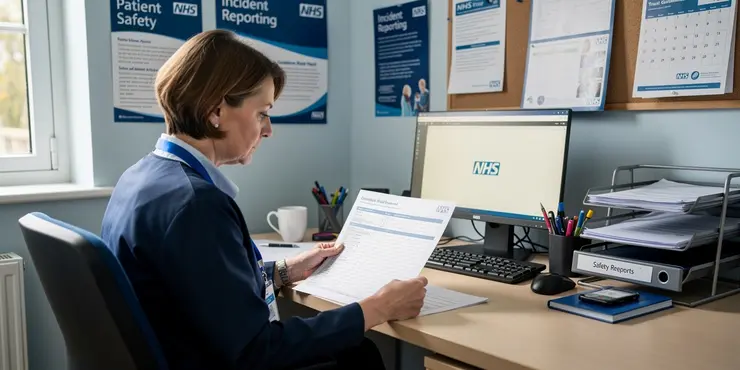
Before making a report, write down exactly what happened. Include the date, time, ward or department, who was involved, and what you saw, heard, or were told. Keep the wording factual and avoid guesses or emotional language.
If the concern relates to a patient, note any immediate harm, changes in condition, or missed care. If you can, record the names and roles of staff who were present. If you are unsure of a detail, say so rather than filling in the gap.
Good documentation is clear, brief, and specific. It helps show what the safety issue was and whether it happened once or more than once.
Before you report, check who to tell first
In many hospitals, the first step is to speak to the nurse in charge, ward manager, or another senior member of staff. If the issue is urgent and a patient is at risk, seek help immediately rather than waiting to write it up.
You can also contact the hospital’s patient safety, risk, or governance team if you are not sure who should handle the concern. Some trusts have a complaints team, incident reporting system, or duty manager for out-of-hours problems.
If you are a staff member, follow your trust’s local policy and escalation route. If you are a patient or relative, ask the ward manager or PALS for guidance on where your concern should go.
Use the right reporting route
Hospitals in the UK often use an internal incident reporting system for patient safety concerns. Staff may need to complete an incident form, often called a Datix report, but the exact system can vary by trust.
If the issue is serious, such as a major fall, medication error, safeguarding concern, or unexpected deterioration, it should be escalated promptly. Some incidents may also need to be reported to senior managers or the on-call doctor as well as entered on the hospital system.
For concerns that are not resolved locally, you may contact PALS, the Care Quality Commission, or the relevant professional regulator depending on the situation. These routes are different from a complaint, so it helps to ask which is most appropriate.
Keep a private record
Make your own dated notes as soon as possible after the event. Keep copies of emails, forms, and any messages about the concern, but do not include confidential patient information unless you are authorised to do so.
Store your notes safely and share them only with people who need to know. A simple record can help you explain the issue clearly if you are asked for more information later.
When the concern is urgent
If there is immediate danger, call for clinical help at once and follow emergency procedures. Do not wait to complete paperwork before seeking support for the patient.
Where possible, note who you informed and when you did it. This creates a clear trail and helps the hospital act quickly and review the concern properly.
Frequently Asked Questions
Documenting patient safety worries hospital where to report means recording concerns about possible harm, unsafe care, or risk events and directing them to the correct hospital reporting channel. It matters because it helps the hospital investigate issues, fix hazards, protect patients, and prevent repeat problems.
You should report concerns through the hospital’s designated safety reporting route, which may include your supervisor, unit manager, patient safety office, risk management, incident reporting system, patient advocate, or ethics hotline. If the situation is urgent or dangerous, escalate immediately according to hospital policy.
Include the date, time, location, people involved, what happened, what you observed, how it affected the patient, and what action was taken. Use objective language, avoid assumptions, and describe facts in enough detail that the hospital can understand and investigate the concern.
Include who was involved, what the safety worry was, when and where it occurred, what the immediate risk was, any injury or harm, who was notified, and whether the patient was stabilized. If your hospital requires a form or ticket number, include that as well.
Anyone who identifies a safety concern can document and report it, including nurses, physicians, aides, therapists, clerical staff, contractors, and sometimes patients or family members. Hospitals usually expect the person who noticed the issue to report it promptly through the proper channel.
Report urgent concerns immediately, especially if there is a risk of serious harm, a medication error, a fall, a wrong-procedure concern, equipment failure, or a missing infection-control safeguard. Do not wait for a routine meeting or end-of-shift if the patient could be harmed now.
Stick to observable facts and avoid blame, emotion, or conclusions that are not supported by evidence. Write what you saw, heard, measured, or were told, and use neutral language such as “the infusion pump alarmed and stopped” instead of “the nurse caused the problem.”
After submitting the report, follow any instructions from the hospital, cooperate with the investigation, and continue to monitor the patient’s condition if needed. If the issue is ongoing or worsens, update the report or escalate it through the appropriate channel.
Yes, many hospitals allow patients and families to report safety worries through patient relations, ombudsman services, bedside staff, or online reporting forms. If the concern is immediate, they should tell staff right away so the issue can be addressed quickly.
Examples include medication mistakes, delays in treatment, misidentification, falls, unsafe equipment, communication breakdowns, infection-control lapses, staffing concerns that create risk, and discharge instructions that could lead to harm. Anything that could reasonably threaten patient safety should be reported.
Be detailed enough that another person can understand what happened without asking for basic clarification. Include the essentials, but keep the report concise, factual, and focused on the safety concern and its impact.
Include names if hospital policy allows and if they help identify the involved patient, staff member, or witness. If names are not required, use role titles or identifiers approved by your hospital, and follow privacy and confidentiality rules.
If you are unsure, start with your immediate supervisor, charge nurse, unit manager, or the hospital operator and ask for the patient safety or risk management reporting process. In a serious or immediate hazard, escalate at once to the fastest available safety channel.
Good documentation creates a record that can be reviewed for patterns, root causes, and system weaknesses. Hospitals can use that information to improve training, fix workflows, repair equipment, change policies, and reduce the chance of similar events happening again.
Avoid rumors, personal opinions, sarcasm, or unsupported accusations. Do not omit key facts, delay reporting serious concerns, or use vague language that makes the risk hard to understand.
Usually, reports are handled within patient safety, risk, or quality systems with confidentiality protections, but the exact rules depend on the hospital and local law. Always follow your facility’s privacy policy and do not share report details unnecessarily.
If the issue is not addressed, escalate it to the next level of management, the patient safety officer, risk management, ethics hotline, or another official escalation path. If there is immediate danger, use the fastest urgent reporting route available without waiting for a response.
Some hospitals allow anonymous reporting through hotlines or online tools, while others require identification for follow-up. Check the hospital’s policy, but remember that anonymous reports may limit the ability to investigate or ask for more details.
Incident forms are often the formal method used to record safety worries and direct them to the right review team. They help standardize what information is captured, make tracking easier, and support investigation and quality improvement.
It should be completed as soon as possible after the event, ideally while the details are still fresh and before the end of the shift if policy requires it. Prompt reporting improves accuracy and helps the hospital respond sooner.

Ergsy Search Results
This website offers general information and is not a substitute for professional advice.
Always seek guidance from qualified professionals.
If you have any medical concerns or need urgent help, contact a healthcare professional or emergency services immediately.
Some of this content was generated with AI assistance. We've done our best to keep it accurate, helpful, and human-friendly.
- Ergsy carefully checks the information in the videos we provide here.
- Videos shown by Youtube after a video has completed, have NOT been reviewed by ERGSY.
- To view, click the arrow in centre of video.
- Most of the videos you find here will have subtitles and/or closed captions available.
- You may need to turn these on, and choose your preferred language.
- Go to the video you'd like to watch.
- If closed captions (CC) are available, settings will be visible on the bottom right of the video player.
- To turn on Captions, click settings.
- To turn off Captions, click settings again.