
Get Answers
What are mitochondrial diseases?
Mitochondrial diseases are a group of conditions that affect how cells make energy. They happen when the mitochondria, often called the “powerhouses” of the cell, do not work properly.
This matters most in tissues that need lots of energy, such as the brain, muscles, heart, eyes and liver. As a result, symptoms can vary widely from person to person.
How genetic mutations are involved
Many mitochondrial diseases are caused by genetic mutations, which are changes in DNA. These mutations can affect the instructions that cells need to build and maintain healthy mitochondria.
The faulty gene may be inherited from a parent, or it may happen for the first time in the person affected. Either way, the mutation can disrupt the way mitochondria produce energy.
Which genes can be affected?
Some mitochondrial disease mutations are found in mitochondrial DNA, which is passed down from the mother. This is because mitochondria are usually inherited through the egg cell.
Other mutations are found in nuclear DNA, which is the DNA inside the cell nucleus. These genes help make proteins needed by mitochondria, so changes in them can also cause disease.
What goes wrong in the cells?
Mutations can stop mitochondria from producing enough energy in the form of ATP. Without enough energy, cells cannot function properly, especially in organs with high energy demands.
In some cases, the mutated mitochondria also produce more harmful by-products, such as reactive oxygen species. These can damage cells further and contribute to symptoms over time.
Why symptoms can be so different
Mitochondrial disease can affect different people in different ways, even within the same family. This happens because some mutations affect only certain tissues, while others are present in many cells.
The severity can also depend on how many mitochondria carry the mutation. If enough healthy mitochondria are present, symptoms may be milder or appear later in life.
What this means for diagnosis and care
Because mitochondrial disease can be caused by many different genetic mutations, diagnosis can take time. Doctors may use blood tests, genetic testing and other investigations to find the cause.
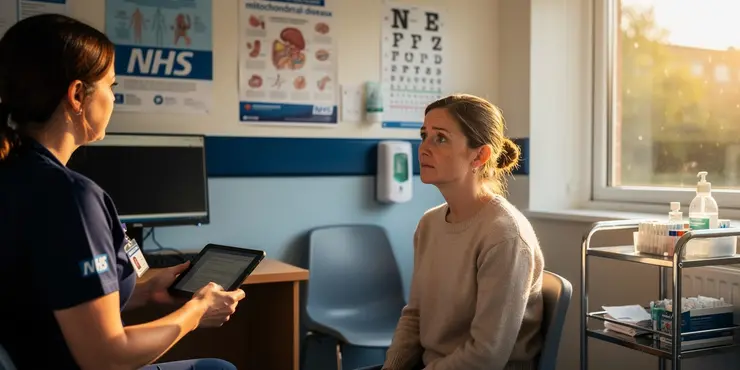
There is no single cure for most mitochondrial diseases, but treatment can help manage symptoms and improve quality of life. In the UK, people may be seen by specialist teams through the NHS for assessment and ongoing care.
Frequently Asked Questions
Genetic mutations that cause mitochondrial disease are changes in mitochondrial DNA or nuclear DNA that disrupt how mitochondria make energy, leading to disease in organs that need a lot of energy.
Genetic mutations can damage proteins involved in energy production, mitochondrial maintenance, or mitochondrial DNA repair, which lowers cellular energy output and can injure tissues over time.
Both mitochondrial genes and many nuclear genes can be involved, including genes that affect the respiratory chain, mitochondrial protein assembly, DNA replication, and mitochondrial transport.
Yes, they can be inherited from a mother, father, or both parents depending on whether the mutation is in mitochondrial DNA, autosomal genes, or X-linked genes.
Yes, some mutations arise de novo, meaning they are new in the affected person and were not previously known in the family.
Symptoms can include muscle weakness, fatigue, exercise intolerance, developmental delay, seizures, vision or hearing problems, heart disease, diabetes, and neurologic issues.
Many organs, such as the brain, muscles, heart, kidneys, and liver, need large amounts of energy, so they are especially vulnerable when mitochondria do not work properly.
Diagnosis often uses a combination of medical history, physical examination, blood and urine tests, imaging, muscle studies, and genetic testing to identify the underlying mutation.
Testing may include mitochondrial DNA sequencing, nuclear gene panels, whole exome sequencing, whole genome sequencing, and targeted testing based on family history or symptoms.
Yes, severity can vary widely depending on the exact mutation, how much mutated mitochondrial DNA is present, and which organs are affected.
There is no universal cure, but treatment may help manage symptoms, support energy needs, prevent complications, and improve quality of life with medications, nutrition, and specialist care.
Not all cases can be prevented, but genetic counseling, carrier testing, and reproductive options may help reduce the risk of passing on certain mutations.
No, many mitochondrial diseases are caused by mutations in nuclear DNA that affect mitochondrial function rather than by mutations in mitochondrial DNA itself.
Yes, some mutations cause severe disease in infancy or childhood, while others present later in adulthood with milder or more slowly progressive symptoms.
They reduce the mitochondria's ability to produce ATP, the cell's main energy source, which leaves tissues with high energy demands unable to function normally.
Yes, because symptoms overlap with many neurological, muscular, metabolic, and cardiac conditions, mitochondrial disease can be difficult to distinguish without genetic testing.
A genetic counselor explains inheritance patterns, testing options, recurrence risk, and family planning choices, and helps families understand test results and next steps.
No, some people have no known family history because the mutation may be new, may show variable expression, or may be inherited in a way that was not previously recognized.
Yes, if a known family mutation is identified, predictive or prenatal testing may detect the mutation before symptoms appear, although it may not predict exact severity.
Care is often managed by a team that may include medical geneticists, neurologists, metabolic specialists, cardiologists, ophthalmologists, audiologists, and physical therapists.

Ergsy Search Results
This website offers general information and is not a substitute for professional advice.
Always seek guidance from qualified professionals.
If you have any medical concerns or need urgent help, contact a healthcare professional or emergency services immediately.
Some of this content was generated with AI assistance. We've done our best to keep it accurate, helpful, and human-friendly.
- Ergsy carefully checks the information in the videos we provide here.
- Videos shown by Youtube after a video has completed, have NOT been reviewed by ERGSY.
- To view, click the arrow in centre of video.
- Most of the videos you find here will have subtitles and/or closed captions available.
- You may need to turn these on, and choose your preferred language.
- Go to the video you'd like to watch.
- If closed captions (CC) are available, settings will be visible on the bottom right of the video player.
- To turn on Captions, click settings.
- To turn off Captions, click settings again.