
Get Answers
Introduction to AI in Lung Cancer Detection
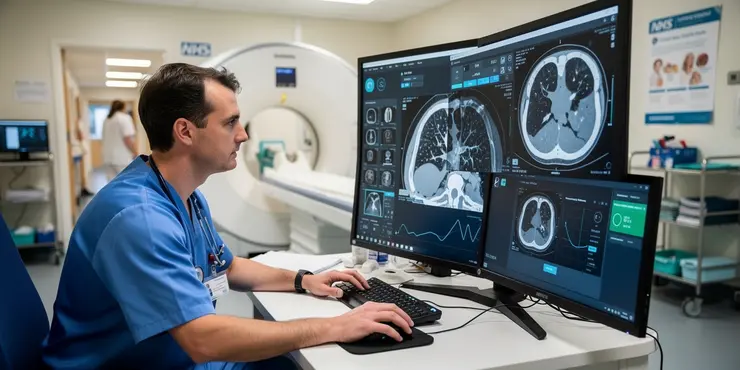
In recent years, artificial intelligence (AI) has gained attention in the field of medical imaging. AI systems are being developed to assist in the early detection and diagnosis of lung cancer. These systems aim to enhance the efficiency and accuracy of radiologists.
Lung cancer remains a leading cause of cancer-related deaths in the UK. Early detection is crucial for improving patient outcomes. AI has the potential to identify nodules in CT scans that may be missed by human eyes.
Current Status of Clinical Validation
The clinical validation of AI systems for lung cancer detection is ongoing. Several studies have shown promising results in lab settings. However, full clinical validation involves rigorous testing and regulatory approval.
AI models need to be thoroughly evaluated in real-world clinical settings. This ensures they provide accurate and reliable results across diverse patient populations. So far, some AI systems have been approved for use after extensive testing.
Challenges in Achieving Clinical Validation
Several challenges exist in the clinical validation process for AI systems. One major concern is the variability in CT image quality and scanning protocols. AI models must be robust enough to handle these variations.
Another challenge is ensuring that AI systems are interpretable and transparent. Clinicians need to trust the AI's results and understand the decision process. Regulatory hurdles also add complexity to the validation process.
Recent Developments and Future Prospects
Recent developments have shown that AI systems can match or exceed radiologists in detecting lung nodules. This motivates ongoing research and investment in the field. Collaborations between technology companies and healthcare providers are crucial for progress.
Future prospects look promising, with AI poised to become an essential tool in lung cancer diagnosis. Continued validation and improvement of AI systems will enhance their utility in clinical practice. The integration of AI could lead to earlier diagnosis and better outcomes for lung cancer patients.
Frequently Asked Questions
AI systems in lung cancer detection aim to enhance the accuracy and efficiency of diagnosing lung cancer by analyzing medical imaging and identifying potential tumors earlier than traditional methods.
Yes, several AI systems for lung cancer detection have undergone clinical validation through studies and trials that demonstrate their efficacy in various settings.
Clinically validated means that the AI system has been tested in clinical settings and has shown reliable results that are comparable to, or better than, existing diagnostic methods.
Clinical validation ensures the safety, accuracy, and reliability of AI systems before they are widely used in patient care, thereby protecting patients and improving diagnostic outcomes.
Studies often include retrospective analyses of medical imaging data, prospective clinical trials, and comparative studies with human radiologists to evaluate the AI's performance.
Yes, some AI systems have received regulatory approval, such as from the FDA or EU CE marking, for use in clinical practice.
AI can process vast amounts of imaging data quickly, identify patterns and anomalies potentially missed by human eyes, and provide decision support to radiologists.
Benefits include increased diagnostic accuracy, faster analysis, reduced human error, and more efficient workflows in healthcare settings.
Challenges include ensuring diverse data representation, maintaining privacy, addressing bias, and integrating AI into existing clinical workflows.
Many studies show AI systems can match or exceed the accuracy of human radiologists in certain tasks, but they are typically used to complement rather than replace human expertise.
AI systems are beginning to be integrated into clinical workflows, especially in large hospitals and specialized centers, although widespread adoption is still in progress.
Regulatory bodies like the FDA in the U.S. ensure that AI systems are safe and effective for use by reviewing validation data and approving systems for clinical use.
Yes, but they need to comply with regional regulations and be validated for the specific population they will be used with, which can vary by country.
By improving early detection and diagnostic accuracy, AI has the potential to positively impact lung cancer survival rates through timely intervention.
AI systems are increasingly used both for screening high-risk populations and assisting in the diagnosis once potential abnormalities are detected.
AI systems must adhere to data protection regulations, such as HIPAA in the U.S., ensuring data is anonymized and secure throughout processing.
Examples include the FDA-approved Optellum's Virtual Nodule Clinic and Thirona's CAD4TB systems, which have proven their effectiveness in studies.
Yes, most AI systems are designed to be compatible with existing radiology infrastructure and can be integrated with PACS and other healthcare databases.
Validation studies aim to include diverse datasets and test across various demographics to ensure the AI system performs consistently well for different patient groups.
Ongoing research focuses on improving algorithm accuracy, expanding functionality to include risk assessment, and integrating with other diagnostic tools for comprehensive care.

Ergsy Search Results
This website offers general information and is not a substitute for professional advice.
Always seek guidance from qualified professionals.
If you have any medical concerns or need urgent help, contact a healthcare professional or emergency services immediately.
Some of this content was generated with AI assistance. We've done our best to keep it accurate, helpful, and human-friendly.
- Ergsy carefully checks the information in the videos we provide here.
- Videos shown by Youtube after a video has completed, have NOT been reviewed by ERGSY.
- To view, click the arrow in centre of video.
- Most of the videos you find here will have subtitles and/or closed captions available.
- You may need to turn these on, and choose your preferred language.
- Go to the video you'd like to watch.
- If closed captions (CC) are available, settings will be visible on the bottom right of the video player.
- To turn on Captions, click settings.
- To turn off Captions, click settings again.