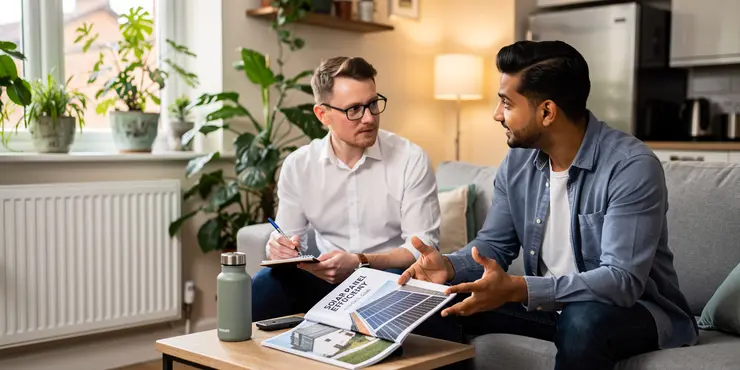

Speak To An Expert
Get clear, personalised advice for your situation.
Jot down a few questions to make the most of your conversation.
Can solar panels still pay for themselves if you use little electricity?
Yes, solar panels can still pay for themselves even if your electricity usage is relatively low, but it usually takes longer. The key factor is not just how much power you use, but how much of the solar electricity you can use directly in your home.
If you are out at work most of the day or use very little electricity overall, a larger share of your solar generation may be exported to the grid. That can still earn money through export payments, but the return is usually lower than the value of using that electricity yourself.
How solar savings work in the UK
In the UK, solar panels reduce the amount of electricity you need to buy from your supplier. Every unit of solar power you use in your home is a unit you do not pay for at your normal electricity rate.
If you have a smart meter or an export tariff, any extra electricity you do not use can be sold back to the grid. However, export rates are often lower than import rates, so self-consumption usually gives the best savings.
Why low usage can mean a longer payback time
Solar panels cost the same to install whether your electricity use is high or low. If your household bills are already small, the annual savings from solar will also be smaller.
That means payback can take longer, especially if you only use electricity in the evenings and weekends. In that case, much of your solar generation may be sent to the grid for a lower return.
Ways low-usage homes can improve the value
Even with low electricity use, you can make solar more worthwhile by shifting some usage to daylight hours. Running appliances like washing machines, dishwashers, or charging a battery during the day can increase your self-use.
Battery storage can also help, but it adds to the upfront cost. For some homes, it makes more sense to start with panels alone and add a battery later if needed.
What matters most when deciding
The best outcome depends on roof size, panel orientation, electricity prices, and how much of your solar power you can use on site. A south-facing roof in good condition will generally produce more electricity than a shaded or poorly angled one.
For a low-usage home, solar panels can still be a sensible long-term investment, especially if electricity prices stay high. The system may not pay back as quickly as it would for a larger household, but it can still reduce bills and provide decent returns over time.
Frequently Asked Questions
Solar panels can pay for themselves with low electricity usage, but it usually takes longer because the system offsets a smaller portion of your bill. Savings come from avoiding utility purchases, and the payback period depends on system cost, incentives, electricity rates, and how much of the solar output you use directly.
Solar panels can pay for themselves with low electricity usage in a reasonable time if installation costs are low, incentives are strong, and electricity prices are high. In many cases, however, the payback period is longer than for households with higher usage because there are fewer savings to offset the upfront cost.
The main factors are system price, local electricity rates, available incentives, roof orientation, sunlight, net metering rules, and whether the home uses most of the solar energy onsite. With low electricity usage, the system must be especially cost-effective to reach payback.
Yes, incentives can make solar panels pay for themselves with low electricity usage more likely and faster. Tax credits, rebates, and favorable net metering can reduce the effective cost and improve returns, which is especially important when annual electricity savings are modest.
Solar panels pay for themselves with low electricity usage more slowly if batteries are added, because batteries increase the upfront cost. Batteries can improve self-consumption and backup power, but they usually extend the payback period unless electricity rates are very high or reliability is a major goal.
Yes, but a small roof limits the size of the system, which also limits savings. Solar panels pay for themselves with low electricity usage more slowly when the system cannot generate much energy, so the economics depend on whether the installed array is still large enough to offset a meaningful share of the bill.
Net metering can significantly improve the economics because it credits excess solar generation sent to the grid. For solar panels pay for themselves with low electricity usage, generous net metering can shorten payback, while weak export credits can make the system less financially attractive.
Yes, high electricity prices improve the odds that solar panels pay for themselves with low electricity usage because each kilowatt-hour offset saves more money. In expensive utility markets, even a modest amount of solar production can generate meaningful annual savings.
They can, but intermittent daytime use may reduce direct solar consumption. Solar panels pay for themselves with low electricity usage best when you can use more solar power while it is being produced, though net metering can still help recover value from excess generation.
The payback period varies widely, but low electricity usage often means a longer payback, sometimes well beyond ten years. The exact timeline depends on installation cost, incentives, sunlight, export credits, and the size of the remaining electric bill.
It can still be worth it if you value lower carbon emissions, energy independence, or backup potential. If your main goal is financial return, solar panels pay for themselves with low electricity usage only when the total system cost and local incentives support a competitive payback period.
A smaller, well-matched system often works better than an oversized one. Solar panels pay for themselves with low electricity usage most effectively when the system is sized to cover a meaningful portion of your annual consumption without producing excessive unused energy.
It is possible, but leasing often lowers the financial upside because the provider captures much of the benefit. Solar panels pay for themselves with low electricity usage more clearly when you own the system, since you keep the savings and incentives.
Seasonal occupancy can make payback harder because electricity use is limited and may not align with production. Solar panels pay for themselves with low electricity usage best when there is enough year-round demand or strong export compensation for excess generation.
Low-interest financing can make the monthly payment easier to manage, but it does not change the actual payback period much. Solar panels pay for themselves with low electricity usage more favorably when the savings exceed the financing costs and the upfront price is reasonable.
Yes, but lower solar production can extend payback. Solar panels pay for themselves with low electricity usage more slowly in cloudy climates unless system costs are low, electricity rates are high, or local incentives significantly improve the economics.
Most solar systems have low maintenance costs, but cleaning, inverter replacement, monitoring, and possible repairs can reduce net savings. When solar panels pay for themselves with low electricity usage, even small maintenance expenses matter more because the savings pool is smaller.
They can, because solar may increase home value in some markets, which improves the overall return. Solar panels pay for themselves with low electricity usage more easily when the combined value of energy savings and home value appreciation exceeds the installed cost.
Estimate annual production, multiply it by your electricity rate and expected self-consumption value, then subtract maintenance and financing costs. Solar panels pay for themselves with low electricity usage only if the total lifetime savings are likely to exceed the all-in system cost within a reasonable time.
The biggest risk is that savings stay too small compared with the upfront cost. Solar panels pay for themselves with low electricity usage only when the system is affordable, incentives are favorable, and the utility savings are high enough to overcome the slower payback from low consumption.

Ergsy Search Results
This website offers general information and is not a substitute for professional advice.
Always seek guidance from qualified professionals.
If you have any medical concerns or need urgent help, contact a healthcare professional or emergency services immediately.
Some of this content was generated with AI assistance. We've done our best to keep it accurate, helpful, and human-friendly.
- Ergsy carefully checks the information in the videos we provide here.
- Videos shown by Youtube after a video has completed, have NOT been reviewed by ERGSY.
- To view, click the arrow in centre of video.
- Most of the videos you find here will have subtitles and/or closed captions available.
- You may need to turn these on, and choose your preferred language.
- Go to the video you'd like to watch.
- If closed captions (CC) are available, settings will be visible on the bottom right of the video player.
- To turn on Captions, click settings.
- To turn off Captions, click settings again.