
Get Answers
Understanding Scabies
Scabies is a skin condition caused by tiny mites called Sarcoptes scabiei. These mites burrow into the skin, causing intense itching and a rash. It is highly contagious and can spread through close personal contact.
The symptoms of scabies include redness, itching, and rash. These are often seen in folds of the skin, between fingers, and around the wrist.
Over-the-Counter Options
In the UK, over-the-counter treatments for scabies are limited. Most effective scabies treatments require a prescription, which means visiting a healthcare provider is essential.
Some pharmacy options may provide relief for symptoms. Topical antihistamines or soothing creams could help ease itching temporarily.
Prescription Treatments
Prescription treatments are the most effective way to eliminate scabies. Permethrin cream and malathion lotion are commonly prescribed in the UK.
These treatments work by killing the mites and their eggs. It's crucial to follow the application instructions from your doctor for them to be effective.
Preventing Reinfection
Preventing reinfestation is crucial in managing scabies. Washing all clothing, bedding, and towels at high temperatures helps eliminate any remaining mites.
Avoiding close contact with infected individuals is also necessary. This includes steering clear of shared bedding or clothes until treatment is complete.
When to Consult a Doctor
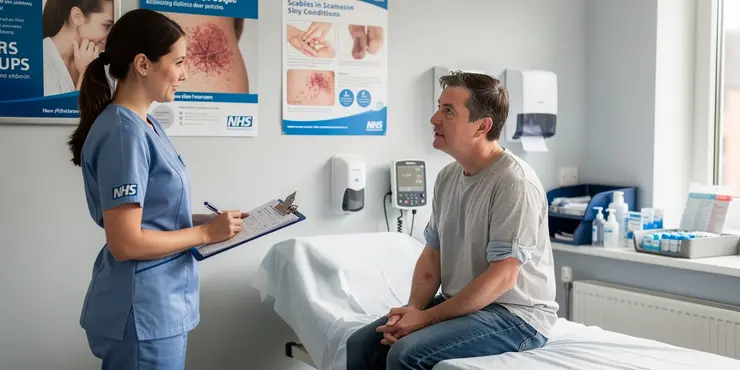
Consult a doctor if you suspect you or someone in your household has scabies. Prompt treatment can reduce discomfort and limit the spread of infestation.
Your doctor can confirm the diagnosis with a simple skin examination. They can also prescribe the most suitable treatment to ensure effective relief.
Frequently Asked Questions
No, scabies usually requires prescription medications for effective treatment.
Over-the-counter medications are not effective against the scabies mite and might not fully eradicate the infestation.
Common prescription treatments include permethrin cream and ivermectin in pill form.
Oral antihistamines can help relieve itching but do not treat the scabies infestation itself.
No, permethrin cream is available by prescription only for treating scabies.
Permethrin cream works by killing the scabies mites and their eggs.
There is no scientific evidence that natural remedies can effectively treat scabies.
Treatment usually takes about 1 to 2 weeks after applying the medication as directed.
Yes, all close contacts and household members should be treated to prevent re-infestation.
A healthcare professional can diagnose scabies through a physical exam and sometimes a skin scraping.
Yes, re-infestation can occur if the source is not eradicated or if treatment is not completed by all contacts.
Avoid direct skin contact with an infested person, and wash clothing and bedding in hot water.
Consult a healthcare professional for diagnosis and appropriate treatment.
Yes, scabies is highly contagious and spreads through direct and prolonged skin contact.
Symptoms include intense itching, red bumps, and burrow tracks on the skin.
Yes, wash bedding and clothing in hot water, and vacuum carpets and furniture.
Symptoms may persist temporarily, but follow up if they do not improve within 4 weeks.
Itching can persist after treatment, but if it decreases over time, the treatment may be effective.
Untreated scabies can lead to skin infections due to intense scratching.
Provide a complete symptom history and ask questions about prescribed medications.

Ergsy Search Results
This website offers general information and is not a substitute for professional advice.
Always seek guidance from qualified professionals.
If you have any medical concerns or need urgent help, contact a healthcare professional or emergency services immediately.
Some of this content was generated with AI assistance. We've done our best to keep it accurate, helpful, and human-friendly.
- Ergsy carefully checks the information in the videos we provide here.
- Videos shown by Youtube after a video has completed, have NOT been reviewed by ERGSY.
- To view, click the arrow in centre of video.
- Most of the videos you find here will have subtitles and/or closed captions available.
- You may need to turn these on, and choose your preferred language.
- Go to the video you'd like to watch.
- If closed captions (CC) are available, settings will be visible on the bottom right of the video player.
- To turn on Captions, click settings.
- To turn off Captions, click settings again.