
Get Answers
Introduction to Lung Cancer Screenings
Lung cancer is a leading cause of cancer-related deaths worldwide. Early detection is crucial to improve survival rates. Traditional screenings involve imaging techniques like CT scans.
These methods are effective but can be resource-intensive and require skilled radiologists. This has led researchers to explore innovative technologies to enhance screenings.
The Role of Robots in Medical Screenings
Robots and artificial intelligence (AI) are increasingly used in healthcare. They can analyse large amounts of data quickly and accurately.
In lung cancer screenings, AI algorithms can assist in identifying nodules from imaging data with high precision. This reduces human error and improves efficiency.
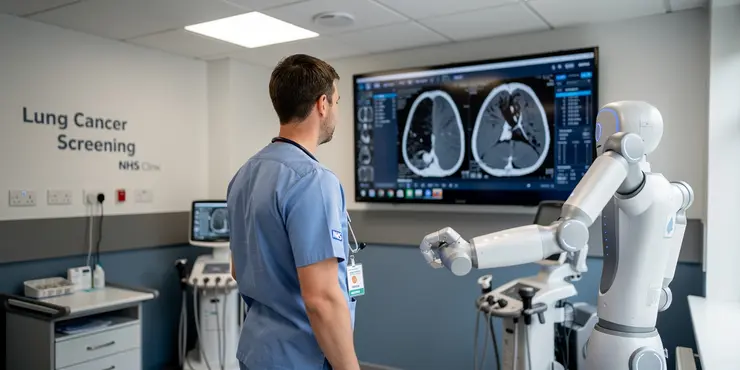
Robots equipped with AI can support doctors by pre-screening images and flagging potential areas of concern. This aids in prioritising cases that need urgent attention.
Benefits of Robotic Assistance
Robots can process complex visual data faster than the human eye. This ensures a quicker turnaround in diagnostic processes for lung cancer.
Their consistent performance helps maintain a high standard of accuracy in screenings. This reduces the likelihood of missed diagnoses.
Moreover, robots can operate tirelessly, allowing continuous screening processes. This is particularly advantageous in regions facing shortages of medical professionals.
Challenges and Considerations
Despite the advantages, integrating robots into lung cancer screenings poses challenges. AI systems require thorough training on diverse data to function effectively.
Privacy concerns arise with the use of patient data in AI training. Ensuring data confidentiality is key to gaining public trust.
Additionally, the cost of implementing robotic systems can be high. This may limit widespread adoption, particularly in less affluent areas.
The Future of Lung Cancer Screenings
The UK health system is monitoring advancements in AI for healthcare applications. As technology evolves, robots could become more involved in routine screenings.
Trials and pilot projects are essential to assess the effectiveness of robots in real-world settings. These initiatives will guide future implementations.
With ongoing investment in technology, robots may significantly enhance the efficiency and accuracy of lung cancer screenings nationwide.
Conclusion
Robots have the potential to transform lung cancer screenings with their speed and precision. While challenges remain, the benefits are considerable.
As research continues, the integration of robots in medical settings looks promising. This can lead to improved outcomes in early cancer detection.
The healthcare industry is poised to innovate and adapt, with robots playing a central role in the future of medical diagnostics.
Frequently Asked Questions
Robots themselves do not perform lung cancer screenings, but they can assist in the process using advanced imaging technologies and AI algorithms to analyze images from screenings like CT scans.
Robots assist by utilizing AI and machine learning algorithms to analyze medical images, identifying potential signs of lung cancer with high precision and helping radiologists in decision-making.
Robots use technologies such as AI, machine learning, computer vision, and advanced medical imaging systems like CT scans and MRIs.
AI systems can be more consistent and sensitive in detecting certain patterns in imaging, and they can assist radiologists by providing a second opinion, but they are typically used in conjunction with human expertise.
Benefits include increased efficiency, higher precision in image analysis, reduced human error, and the ability to process large volumes of data quickly.
Currently, AI is used to support radiologists by providing additional insights and reducing their workload, but it does not fully replace the need for human expertise and judgment.
AI algorithms can be very reliable, but their effectiveness depends on the quality and quantity of the training data and they are most effective when used alongside human expertise.
Yes, by analyzing images with high precision, AI can help in identifying cancerous patterns earlier than traditional methods, aiding in early detection.
Healthcare professionals verify AI findings, make clinical decisions, and provide the necessary evaluation and context that AI systems cannot.
Potential risks include over-reliance on AI outputs, misinterpretation of data without considering clinical context, and privacy concerns related to data handling.
The future may involve more integrated AI solutions that work seamlessly with diagnostics and treatment, as well as improvements in algorithm accuracy and efficiency.
AI algorithms are trained using large datasets of labeled medical images, where patterns indicative of lung cancer are identified and used to teach the algorithms.
The initial setup and technology investment for AI can be more expensive, but it may reduce costs over time by increasing efficiency and reducing the need for follow-up testing.
Patients may benefit from faster diagnosis, potentially earlier detection of diseases, and reduced wait times for imaging results.
Regulatory bodies like the FDA assess the safety, efficacy, and reliability of AI systems in healthcare to ensure they meet standards before approval for clinical use.
Adoption varies by region due to factors like healthcare infrastructure, cost, regulatory environments, and healthcare providers' acceptance of new technologies.
AI systems typically employ encryption and data anonymization techniques to protect patient privacy during data processing and analysis.
Yes, some AI systems are also designed to assess risk factors and predict the likelihood of developing lung cancer based on patient data and history.
Ethical concerns include patient privacy, data security, the potential for algorithmic bias, and the need for informed consent when using AI-driven diagnoses.
Professionals need to be educated on how AI systems work, their strengths, limitations, and how to interpret AI outputs accurately in a clinical context.

Ergsy Search Results
This website offers general information and is not a substitute for professional advice.
Always seek guidance from qualified professionals.
If you have any medical concerns or need urgent help, contact a healthcare professional or emergency services immediately.
Some of this content was generated with AI assistance. We've done our best to keep it accurate, helpful, and human-friendly.
- Ergsy carefully checks the information in the videos we provide here.
- Videos shown by Youtube after a video has completed, have NOT been reviewed by ERGSY.
- To view, click the arrow in centre of video.
- Most of the videos you find here will have subtitles and/or closed captions available.
- You may need to turn these on, and choose your preferred language.
- Go to the video you'd like to watch.
- If closed captions (CC) are available, settings will be visible on the bottom right of the video player.
- To turn on Captions, click settings.
- To turn off Captions, click settings again.