
Speak To An Expert
Get clear, personalised advice for your situation.
Jot down a few questions to make the most of your conversation.
Understanding Psoriasis
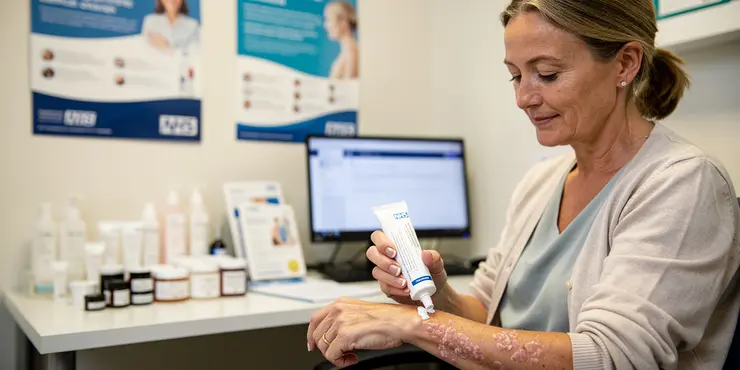
Psoriasis is a chronic autoimmune condition that causes rapid skin cell proliferation, leading to scaling on the skin’s surface. This manifests typically in the form of red patches covered with thick, silvery scales. Psoriasis can be itchy and sometimes painful. While it can affect any part of the body, it most commonly occurs on the scalp, elbows, knees, and lower back. The severity of psoriasis varies from person to person, ranging from minor localized patches to complete body coverage.
Over-the-Counter (OTC) Treatments in the UK
In the UK, several over-the-counter (OTC) treatments are available to help manage the symptoms of psoriasis. These treatments aim to reduce scaling, itchiness, and inflammation associated with the condition. While they do not cure psoriasis, they can help provide relief and maintain healthier skin.
Available OTC Options
Common OTC treatments include topical ointments, creams, and shampoos that contain active ingredients designed to soothe the skin. Some of the widely used components found in these products are coal tar, salicylic acid, and moisturizers containing emollients.
Coal tar, a by-product of coal, has been used for decades to treat psoriasis. It can help slow the rapid growth of skin cells and improve the skin's appearance. Products containing coal tar may be available in shampoos, creams, and bath solutions. However, they can have a strong odour and may stain clothing.
Salicylic acid is another common ingredient in OTC psoriasis treatments. It helps remove scales and promotes smoother skin. When used in combination with other treatments, such as topical corticosteroids, salicylic acid can enhance their effectiveness.
Emollients and moisturizers play a crucial role in managing psoriasis as they help keep the skin hydrated and reduce the itch. Regular use can help prevent new flare-ups and maintain the skin's barrier function.
Considerations and Limitations
While OTC treatments can offer relief, they may not be effective for everyone, especially for those with moderate to severe psoriasis. People with extensive psoriasis or those not experiencing relief from OTC solutions should consult a healthcare professional for potential prescription treatments. It's essential to read and follow product instructions carefully, as overuse or misuse could irritate the skin or exacerbate symptoms.
Allergy or sensitivity testing is advisable before using new treatments to avoid adverse reactions, especially for individuals with sensitive skin. Additionally, combining OTC products with certain prescription medications should be done under medical advice to prevent any possible interactions.
Conclusion
OTC treatments can play a valuable role in managing mild to moderate psoriasis symptoms. However, they are most effective when integrated into a broader skincare routine tailored to individual needs. For persistent or severe cases, seeking professional medical advice is recommended to explore more comprehensive treatment options available through the NHS or private healthcare providers in the UK.
Understanding Psoriasis
Psoriasis is a skin problem that lasts a long time. It makes your skin grow too fast and causes thick, flaky patches. These patches are usually red with white scales. They can be itchy and sometimes hurt. Psoriasis can appear anywhere on your body, but it usually shows up on your scalp, elbows, knees, and lower back. Some people have small patches, while others might have it all over.
Over-the-Counter (OTC) Treatments in the UK
In the UK, you can buy some treatments without a prescription to help with psoriasis. These can help with the flakiness, itching, and redness. They won’t cure psoriasis, but they can make your skin feel better.
Available OTC Options
Common treatments you can buy include creams, ointments, and shampoos. These have special ingredients to calm the skin. Some of these ingredients are coal tar, salicylic acid, and moisturizers.
Coal tar comes from coal and has been used for a long time to help psoriasis. It can slow down the fast skin growth and make the skin look better. You can find coal tar in shampoos, creams, and bath products. It might smell strong and can stain clothes.
Salicylic acid is another ingredient that helps with psoriasis. It takes away the scales and makes the skin smoother. It can work better when used with other treatments.
Moisturizers and creams keep your skin soft and stop the itch. Using them often can help stop new patches from forming and keep your skin healthy.
Considerations and Limitations
These treatments might not work for everyone, especially if your psoriasis is more serious. If you have a lot of psoriasis or these treatments don’t help, talk to a doctor. You should read and follow the instructions on the products carefully. Using them too much might irritate your skin.
If you have sensitive skin, it's a good idea to test a small amount first to make sure it doesn’t cause a reaction. If you’re using other medicines, check with a doctor before combining them.
Conclusion
Treatments you can buy without a prescription can help with mild psoriasis. They work best when you take good care of your skin overall. If your psoriasis is bad or doesn’t get better, see a doctor. They can tell you about other treatments that might help.
Frequently Asked Questions
Over-the-counter treatments for psoriasis are non-prescription products that can help reduce scaling, itching, dryness, and mild inflammation. Common options include moisturizers, coal tar products, salicylic acid, and anti-itch creams.
For dry, scaly plaques, thick moisturizers, salicylic acid products, and coal tar preparations often help soften scale and reduce flaking. Regular use of fragrance-free emollients can also improve skin comfort.
Over-the-counter treatments for psoriasis may reduce itching by hydrating the skin, soothing irritation, and decreasing scale buildup. Products with colloidal oatmeal, pramoxine, or moisturizing ingredients can be helpful for some people.
Many over-the-counter treatments for psoriasis, especially moisturizers, are safe for daily use. Some active ingredients, such as salicylic acid or coal tar, should be used according to the label because overuse can irritate skin.
Common ingredients in over-the-counter treatments for psoriasis include salicylic acid, coal tar, lactic acid, urea, colloidal oatmeal, hydrocortisone, and moisturizing agents like petrolatum or ceramides.
Yes, some over-the-counter treatments for psoriasis can help loosen thick plaques, especially salicylic acid, urea, and coal tar products. These ingredients may soften hardened scale and make plaques easier to manage.
Over-the-counter treatments for psoriasis may begin easing dryness or itch within days, but visible improvement in scaling and redness can take several weeks. Consistent use is often needed for the best results.
Yes, some over-the-counter treatments for psoriasis are formulated for the scalp, including medicated shampoos and topical solutions containing coal tar or salicylic acid. These can help reduce flaking and buildup on the scalp.
Over-the-counter treatments for psoriasis are usually most helpful for mild psoriasis and for supporting skin care in more moderate cases. More widespread, painful, or persistent psoriasis often needs prescription treatment.
Over-the-counter treatments for psoriasis are often used alongside prescription medicines, but the combination should be reviewed with a healthcare professional. Some ingredients may irritate skin or interfere with other treatments.
Possible side effects of over-the-counter treatments for psoriasis include skin irritation, stinging, dryness, redness, or allergic reactions. Coal tar products can also stain fabrics and may increase sun sensitivity.
Over-the-counter treatments for psoriasis should generally be applied to clean, dry skin as directed on the label. Moisturizers are often most effective after bathing, while medicated products should be used only as directed.
Some over-the-counter treatments for psoriasis may be considered during pregnancy, but not all are appropriate. A healthcare professional should be consulted before using products with active ingredients such as salicylic acid or coal tar.
Some over-the-counter treatments for psoriasis may be suitable for children, but product choice and dosage should be age-appropriate. It is best to confirm with a pediatrician before using medicated products on a child.
No, over-the-counter treatments for psoriasis do not cure psoriasis. They can help manage symptoms such as itching, scaling, and dryness, but psoriasis is a chronic condition that may require ongoing care.
Over-the-counter treatments for psoriasis should be replaced with medical care if symptoms are severe, spreading, painful, infected, or not improving after several weeks. A clinician can recommend stronger or more targeted treatment.
Yes, over-the-counter treatments for psoriasis can help reduce flare-ups by keeping skin moisturized and limiting dryness and irritation. Regular skin care and trigger avoidance may also help prevent worsening.
When choosing over-the-counter treatments for psoriasis, people should look for the type of symptoms they want to treat, such as scale, itch, or dryness. Fragrance-free moisturizers and active ingredients suited to the affected area are often good starting points.
Yes, over-the-counter treatments for psoriasis may differ depending on whether they are used on the face, body, or scalp. The face usually needs gentler products, while the scalp may benefit from shampoos or solutions designed for hair-bearing skin.
Some over-the-counter treatments for psoriasis can be used in sensitive areas, but caution is important because certain ingredients may irritate delicate skin. Gentle moisturizers are often preferred, and medicated products should be used carefully or under medical guidance.

Ergsy Search Results
This website offers general information and is not a substitute for professional advice.
Always seek guidance from qualified professionals.
If you have any medical concerns or need urgent help, contact a healthcare professional or emergency services immediately.
Some of this content was generated with AI assistance. We've done our best to keep it accurate, helpful, and human-friendly.
- Ergsy carefully checks the information in the videos we provide here.
- Videos shown by Youtube after a video has completed, have NOT been reviewed by ERGSY.
- To view, click the arrow in centre of video.
- Most of the videos you find here will have subtitles and/or closed captions available.
- You may need to turn these on, and choose your preferred language.
- Go to the video you'd like to watch.
- If closed captions (CC) are available, settings will be visible on the bottom right of the video player.
- To turn on Captions, click settings.
- To turn off Captions, click settings again.