
Get Answers
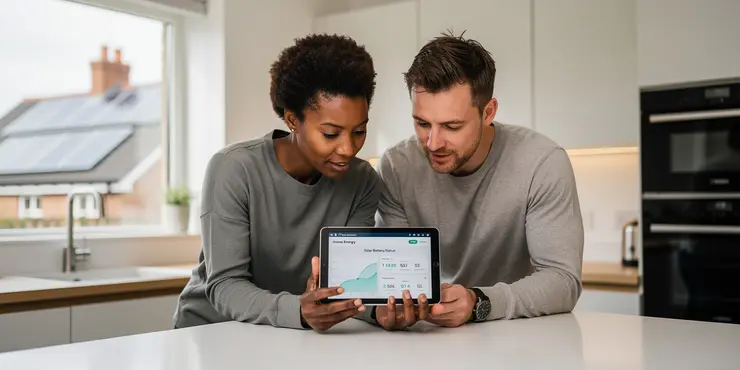
Can a battery system improve solar exports?
Yes, a battery system can help you sell solar electricity back to the grid more effectively. Instead of sending every spare unit of electricity straight away, a battery lets you store excess generation and export it later.
This can be especially useful in the UK, where solar output is often highest in the middle of the day. If your household uses less electricity at that time, a battery can capture the surplus for later use or for export when prices may be better.
Why timing matters
Electricity export payments can vary depending on your tariff and supplier. Some export rates are fixed, while others may change by time of day or market conditions.
With a battery, you may be able to avoid exporting when your system is producing the most but prices are low. Instead, you can store that electricity and release it at a more valuable time, if your tariff rewards flexibility.
More than just higher export value
A battery does not only help with export revenue. It can also increase your own use of solar power by reducing the amount you need to buy from the grid.
That matters because self-consumed solar usually saves more money than exported solar earns. By using more of your own generation first, a battery can improve the overall financial return from your system.
What to check before investing
Battery systems can be expensive, so the numbers need to stack up. The benefit depends on your solar array size, household electricity use, export tariff, and how much battery capacity you need.
You should also check whether your export tariff allows battery storage and later export. Some schemes have rules that affect how payments are calculated, so it is worth reading the small print carefully.
Is it worth it in the UK?
For many UK homes, a battery can make solar more useful and potentially more profitable. It is often most attractive for households that use a lot of electricity in the evening or want greater control over their energy bills.
However, it is not guaranteed to increase export income on its own. The real value comes from combining smarter self-use, better timing, and the right export tariff for your setup.
Frequently Asked Questions
It means you use solar panels to generate electricity, store some of it in a battery, and export excess power to the utility grid when allowed by your tariff, inverter, and local utility rules.
Your solar panels power your home first, the battery stores leftover energy, and any additional surplus can be sent to the grid through a grid-tied inverter if export is enabled.
Eligibility usually depends on having a grid-connected solar and battery setup, approval from your utility, a compatible meter, and compliance with local interconnection and safety requirements.
You typically need solar panels, a battery, a hybrid or grid-tied inverter, a smart meter or net meter, disconnects, and utility-approved protection equipment.
Yes, a battery can help you store solar energy and export it later when rates are higher, if your utility offers time-based pricing or favorable export compensation.
Net metering is a billing arrangement where excess solar electricity exported to the grid earns credits that offset electricity you draw from the grid later.
Net metering usually credits exported electricity against your usage, while feed-in tariffs pay a set rate for each kilowatt-hour you export to the grid.
Earnings vary widely based on system size, local electricity prices, export rates, battery capacity, sunshine levels, and how much surplus energy you actually export.
Yes, most utilities require interconnection approval, and some locations also require permits, inspections, and proof that your equipment meets electrical codes.
Usually not, because grid-tied systems shut down during outages for safety unless you have backup functionality designed to isolate your home from the grid.
When the battery charges first, less solar power may be exported immediately, but a well-managed system can later discharge the battery to maximize value based on rates and demand.
A hybrid inverter is often best because it can manage solar production, battery charging, home loads, and grid export in one integrated system.
Smart meters measure both imported and exported electricity, allowing the utility to accurately bill you and apply credits or payments for exported solar power.
Main risks include poor financial returns from unfavorable tariffs, battery degradation, installation issues, utility rule changes, and safety problems if the system is not properly installed.
Payback time depends on installation cost, incentives, export compensation, self-consumption savings, and battery performance, and it often ranges from several years to more than a decade.
It is usually difficult unless you have dedicated roof access, ownership rights, and utility approval, though some shared-solar or community-solar arrangements may be available.
Maintenance typically includes checking inverter performance, monitoring battery health, keeping panels clean, reviewing alerts, and ensuring all electrical components remain compliant and safe.
Yes, cloudy weather, seasonal changes, shading, and temperature can reduce solar production and therefore reduce the amount of excess electricity available for export.
Tariffs determine how much you are paid or credited for exported electricity, so time-of-use rates and export limits can greatly affect the financial value of your system.
You should ask about export compensation, interconnection rules, meter requirements, battery export limits, application fees, outage behavior, and any restrictions on system size or configuration.

Ergsy Search Results
This website offers general information and is not a substitute for professional advice.
Always seek guidance from qualified professionals.
If you have any medical concerns or need urgent help, contact a healthcare professional or emergency services immediately.
Some of this content was generated with AI assistance. We've done our best to keep it accurate, helpful, and human-friendly.
- Ergsy carefully checks the information in the videos we provide here.
- Videos shown by Youtube after a video has completed, have NOT been reviewed by ERGSY.
- To view, click the arrow in centre of video.
- Most of the videos you find here will have subtitles and/or closed captions available.
- You may need to turn these on, and choose your preferred language.
- Go to the video you'd like to watch.
- If closed captions (CC) are available, settings will be visible on the bottom right of the video player.
- To turn on Captions, click settings.
- To turn off Captions, click settings again.