
Get Answers
Is breastfeeding in public culturally accepted in the UK?
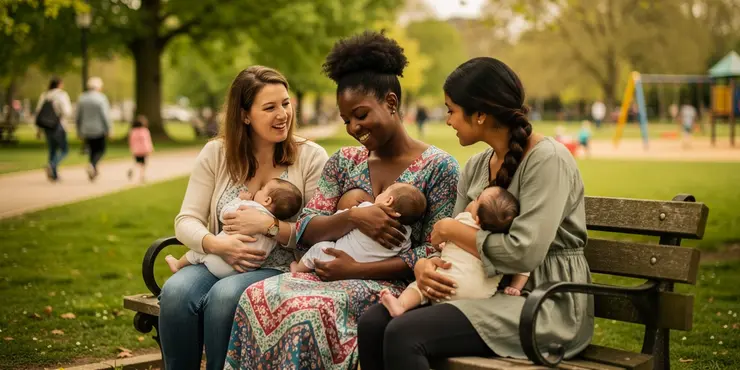
In the UK, breastfeeding in public is generally accepted, but attitudes can vary depending on the setting and the people around you. Many mothers breastfeed openly in cafés, parks, shops, and on public transport without issue.
At the same time, some people still feel uncomfortable, often because they are unsure what is appropriate rather than because they oppose breastfeeding itself. This can make the experience feel more awkward than it should be.
What does the law say?
In the UK, breastfeeding is protected in many public and private places. It is illegal to ask a breastfeeding mother to stop or move if she is using a service or visiting a venue that serves the public.
This legal protection reflects the broader view that feeding a baby is a normal part of daily life. It also helps reassure mothers that they have the right to feed their child when needed.
How attitudes have changed
Public attitudes have improved a lot over the past few decades. Campaigns promoting breastfeeding awareness have helped normalise it, and many people now see it as a routine family matter.
Social media has also played a role in making breastfeeding more visible. Seeing other parents feed confidently in public has helped reduce the sense that it should be hidden away.
Why some mothers still feel judged
Even though breastfeeding is accepted in principle, not everyone feels comfortable doing it in public. Some mothers worry about unwanted attention, comments, or being stared at.
This can be influenced by cultural background, personal experience, or the specific environment. For example, a busy restaurant may feel different from a quiet family area or a breastfeeding-friendly venue.
How the UK compares in everyday life
In many parts of the UK, especially larger cities and family-oriented places, breastfeeding in public is seen as completely ordinary. Shops, community spaces, and transport hubs are often used to seeing parents feed babies wherever needed.
That said, acceptance is not always consistent. Some local cultures, communities, or generations may be more reserved, so reactions can still vary from place to place.
Conclusion
Overall, breastfeeding in public is culturally accepted in the UK, and most people view it as a normal and protected part of parenting. While discomfort still exists in some situations, the wider social trend is toward acceptance and support.
For many parents, the main challenge is not the act of breastfeeding itself, but feeling confident doing so in public. As awareness continues to grow, public breastfeeding is likely to become even more normalised.
Frequently Asked Questions
Breastfeeding in public cultural acceptance UK refers to how socially acceptable and normal it is for mothers to feed their babies in public spaces across the UK. In general, it is widely supported and legally protected, though individual comfort levels and local attitudes can still vary.
Yes, breastfeeding in public cultural acceptance UK is supported by UK law. In many settings, including shops, cafes, and public venues, it is unlawful to ask a breastfeeding mother to leave or treat her unfairly because she is breastfeeding.
Breastfeeding in public cultural acceptance UK can vary because attitudes are shaped by local culture, age, community norms, and individual experience. Urban areas may feel more normalized, while some people in any region may still be less familiar or comfortable with it.
Breastfeeding in public cultural acceptance UK is increasingly common and broadly accepted by many people. Public health campaigns, legal protections, and changing social attitudes have helped make it more visible and normalized.
Challenges in breastfeeding in public cultural acceptance UK can include fear of unwanted attention, worry about judgment, lack of suitable seating, and uncertainty about where breastfeeding is welcome. These concerns often matter more than actual legal restrictions.
Businesses can improve breastfeeding in public cultural acceptance UK by training staff, displaying welcoming policies, providing comfortable seating, and responding supportively if a customer breastfeeds. Clear acceptance helps mothers feel respected and comfortable.
If someone faces discrimination related to breastfeeding in public cultural acceptance UK, they should record what happened, speak to the manager or venue owner, and consider seeking advice from relevant support organisations. In serious cases, legal advice may be appropriate.
Social media has increased visibility of breastfeeding in public cultural acceptance UK by sharing real-life experiences, advocacy messages, and legal information. It has also sparked debate, but generally it has helped normalize public breastfeeding.
Health professionals help strengthen breastfeeding in public cultural acceptance UK by encouraging breastfeeding, offering practical guidance, and reassuring parents about their rights. Their support can reduce anxiety about feeding outside the home.
Yes, breastfeeding in public cultural acceptance UK is often discussed separately from bottle feeding because breastfeeding can attract more social scrutiny despite being a normal infant-care activity. Public acceptance has improved, but some stigma still exists for breastfeeding specifically.
Family attitudes can strongly influence breastfeeding in public cultural acceptance UK because support from partners, grandparents, and relatives can make mothers feel more confident. Unsupportive family views may increase hesitation even when society is generally accepting.
Breastfeeding in public cultural acceptance UK is typically most accepted in places such as shopping centres, cafes, parks, libraries, and transport hubs, especially where staff are familiar with the law. Many venues now actively welcome breastfeeding parents.
Breastfeeding in public cultural acceptance UK is generally considered moderate to high compared with many countries, with strong legal protection and growing social acceptance. However, cultural comfort levels can still be more conservative than in some places and more liberal than in others.
Pregnant people can prepare for breastfeeding in public cultural acceptance UK by learning their rights, practicing comfortable feeding positions, choosing easy-to-wear clothing, and identifying supportive public venues. Preparation often makes public feeding feel much less daunting.
Media portrayals affect breastfeeding in public cultural acceptance UK by shaping whether public breastfeeding appears normal, awkward, or controversial. Positive coverage can reduce stigma, while sensational stories can discourage confidence.
Modesty concerns often influence breastfeeding in public cultural acceptance UK because some mothers worry about exposing skin or attracting attention. Many people find practical solutions such as layered clothing, but the choice should always be based on the mother's comfort.
Yes, workplaces are part of breastfeeding in public cultural acceptance UK because some mothers need to breastfeed or express milk during work hours. Supportive workplace policies, private spaces, and flexible breaks can improve acceptance and access.
Community groups can support breastfeeding in public cultural acceptance UK by offering peer support, public awareness campaigns, breastfeeding-friendly meetups, and clear information about rights. Community encouragement often helps normalize breastfeeding in everyday life.
Common misconceptions that reduce breastfeeding in public cultural acceptance UK include the idea that breastfeeding is inappropriate in public, that it should always be hidden, or that it disturbs others. In reality, public breastfeeding is a normal, lawful, and healthy practice.
Future trends shaping breastfeeding in public cultural acceptance UK may include stronger public education, more breastfeeding-friendly venues, better workplace support, and continued normalization through media and community advocacy. These changes may make public breastfeeding feel even more routine.

Ergsy Search Results
This website offers general information and is not a substitute for professional advice.
Always seek guidance from qualified professionals.
If you have any medical concerns or need urgent help, contact a healthcare professional or emergency services immediately.
Some of this content was generated with AI assistance. We've done our best to keep it accurate, helpful, and human-friendly.
- Ergsy carefully checks the information in the videos we provide here.
- Videos shown by Youtube after a video has completed, have NOT been reviewed by ERGSY.
- To view, click the arrow in centre of video.
- Most of the videos you find here will have subtitles and/or closed captions available.
- You may need to turn these on, and choose your preferred language.
- Go to the video you'd like to watch.
- If closed captions (CC) are available, settings will be visible on the bottom right of the video player.
- To turn on Captions, click settings.
- To turn off Captions, click settings again.