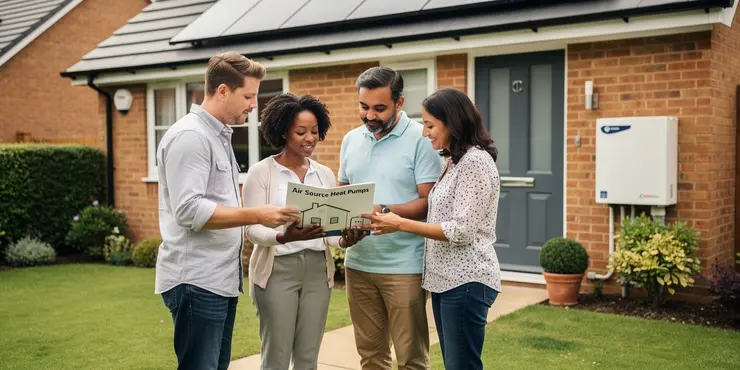

Get Answers
Are air source heat pumps suitable for all homes?
Air source heat pumps are a popular low-carbon heating option, but they are not the right fit for every property. In simple terms, they work best when a home can retain heat well and use lower flow temperatures efficiently. That means some houses will be a better match than others.
For many UK homeowners, they can be a practical replacement for a gas boiler. However, the type of home, its insulation, and the current heating system all affect whether installation will be straightforward or costly.
Which homes tend to work best?
Homes with good insulation usually see the best results from an air source heat pump. This includes properties with loft insulation, cavity wall insulation, and reasonably modern windows. A well-insulated home needs less heat overall, which helps the system run more efficiently.
Detached, semi-detached, and newer homes often suit heat pumps well, especially if they already have larger radiators or underfloor heating. These systems can distribute warmth effectively at the lower temperatures heat pumps typically produce.
Homes that may need extra work
Older homes can still use air source heat pumps, but they may need upgrades first. Solid wall properties, draughty houses, or homes with poor insulation may struggle to stay warm without improvements. In these cases, the heat pump may have to work harder, which can reduce efficiency.
Small radiators and an aging heating system can also be an issue. A homeowner may need to replace radiators, improve insulation, or make electrical upgrades before installation, which adds to the overall cost.
What about flats and terraces?
Flats can sometimes be suitable, but space and permissions may be limiting factors. There needs to be enough room for the external unit, and building regulations or lease agreements may affect what can be installed. Noise and access can also matter in shared buildings.
Terraced homes may work well if they are properly insulated and have suitable outdoor space. However, each property should be assessed individually, as there is no one-size-fits-all answer.
How to decide if your home is suitable
The best starting point is a professional survey from a qualified installer. They will look at heat loss, insulation levels, radiator size, and available outdoor space. This helps determine whether a heat pump is a sensible choice or whether upgrades are needed first.
For many UK homeowners, the answer is yes with the right preparation. Air source heat pumps are not suitable for every home as it stands, but a wide range of properties can be made ready for them with sensible improvements.
Frequently Asked Questions
Air source heat pumps are often well suited to detached houses because they usually have more outdoor space for the unit, fewer shared walls, and better opportunities to improve insulation and heat distribution. They can work efficiently in many detached homes, especially where the property can be kept at a steady lower flow temperature.
Semi-detached houses can be suitable for air source heat pumps if the building is reasonably insulated and there is enough external space for installation. Heat loss is often lower than in fully detached properties, which can help system efficiency, but neighboring walls and layout still need to be considered.
Terraced houses can be suitable for air source heat pumps, particularly when the home has been upgraded with insulation and draught-proofing. Because terraced homes often lose less heat through exposed walls than detached homes, they may need less heating energy, but limited outdoor space and noise placement need careful planning.
Flats and apartments can sometimes be suitable for air source heat pumps, but suitability depends on ownership, external access, planning rules, and whether there is space for the outdoor unit. Communal buildings may also require landlord or freeholder approval, and internal heat distribution must be checked carefully.
Bungalows are often suitable for air source heat pumps because they usually have a simple layout, good access for installation, and relatively easy pipe routing. Their suitability still depends on insulation, existing heating system type, and whether the outdoor unit can be positioned with enough airflow.
Period properties can be suitable for air source heat pumps if they are assessed carefully for insulation levels, draft reduction, and radiator sizing. Older homes often need upgrades to reduce heat loss, but with proper preparation they can work well with an air source heat pump system.
New-build homes are often highly suitable for air source heat pumps because they typically have better insulation, airtightness, and modern heating distribution systems. These features reduce heat demand and allow the pump to operate efficiently at lower temperatures.
Older homes can be suitable for air source heat pumps, but only after checking insulation, window performance, and emitter size. If heat loss is high, the home may need upgrades such as loft insulation or larger radiators to make the system effective and economical.
Small homes can be suitable for air source heat pumps because they generally need less heat overall, which can reduce running costs and make lower output systems effective. The main challenges are finding enough space for the external unit and ensuring the heating system is correctly balanced.
Large homes can be suitable for air source heat pumps if the heating load is calculated correctly and the system is sized to match the property. Larger properties may need more than one heating circuit or careful zoning to keep temperatures even throughout the home.
Homes with poor insulation are usually less suitable for air source heat pumps until improvements are made. Because heat pumps work best at lower temperatures, high heat loss can lead to inefficient operation, so insulation upgrades are often recommended before installation.
Homes with underfloor heating are often very suitable for air source heat pumps because underfloor systems run at low temperatures that match heat pump performance well. This can improve efficiency and comfort, especially in well-insulated properties.
Homes with radiators can be suitable for air source heat pumps if the radiators are large enough to deliver heat at lower flow temperatures. In some homes, radiator upgrades may be needed to maintain comfort and ensure the system works efficiently.
Homes with limited outdoor space can still be suitable for air source heat pumps if there is enough room for the external unit, adequate airflow, and proper positioning away from obstructions. Compact or wall-mounted solutions may help, but site constraints must be checked first.
Homes in noisy or tightly packed neighborhoods can still be suitable for air source heat pumps, but careful placement is important to reduce sound impact on occupants and neighbors. The outdoor unit should be positioned with consideration for planning rules, boundaries, and acoustic performance.
Off-grid homes can be suitable for air source heat pumps if they have a reliable electricity supply, sufficient backup planning, and good insulation. Because the system runs on electricity, energy management and any renewable generation on site can be especially important.
Homes with existing gas boilers can be suitable for air source heat pumps as a full replacement or as part of a hybrid system. Suitability depends on the home's heat loss, radiator setup, and whether the household wants to move to a lower-carbon heating system.
Homes with timber frames can be suitable for air source heat pumps if the building fabric is well insulated and moisture risks are managed correctly. Proper design is important to ensure efficient heating, airtightness, and long-term building performance.
Rental properties can be suitable for air source heat pumps, but installation usually depends on landlord approval, tenant needs, and building condition. The property must also be assessed for insulation, space, and the practicality of any required heating upgrades.
Listed buildings or homes in conservation areas can sometimes be suitable for air source heat pumps, but extra planning and heritage constraints may apply. The main factors are whether the external unit can be placed discreetly and whether the installation respects the building's character and local rules.

Ergsy Search Results
This website offers general information and is not a substitute for professional advice.
Always seek guidance from qualified professionals.
If you have any medical concerns or need urgent help, contact a healthcare professional or emergency services immediately.
Some of this content was generated with AI assistance. We've done our best to keep it accurate, helpful, and human-friendly.
- Ergsy carefully checks the information in the videos we provide here.
- Videos shown by Youtube after a video has completed, have NOT been reviewed by ERGSY.
- To view, click the arrow in centre of video.
- Most of the videos you find here will have subtitles and/or closed captions available.
- You may need to turn these on, and choose your preferred language.
- Go to the video you'd like to watch.
- If closed captions (CC) are available, settings will be visible on the bottom right of the video player.
- To turn on Captions, click settings.
- To turn off Captions, click settings again.